Habi Philippine Textile Council (Habi) took a significant step to partner with Fashion Revolution Philippines (Fash Rev PH). They aim to promote sustainable and ethical fashion. They partnered for a series of engaging workshops during the Habi Market Fair. The event took place from October 18th to 20th, 2024, at the Glorietta Activity Center in Makati City. It highlighted the incredible talent of Filipino weavers. The beauty of natural textiles was also showcased. Additionally, the importance of supporting local brands was emphasized.
This partnership marked a first for Fash Rev PH. It merged their passion for ethical fashion with Habi’s dedication to preserving and promoting the heritage of Philippine textiles. The workshops were vibrant with creativity. They offered a unique opportunity for attendees to immerse themselves in the world of weaving. Additionally, they promoted sustainable practices.
The event kicked off with a captivating introduction to the art of weaving, led by Twinkle Ferraren. Participants experienced the joy of creating something with their own hands. This fostered a sense of accomplishment. It also sparked a creative fire within each attendee.
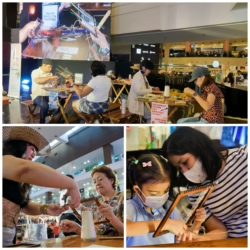
On the second day, Ili Likahaan led a mesmerizing Botanical Eco-printing workshop. Participants discovered the magic of transforming natural textiles using flowers and the rhythmic beat of hammers. This experience was not just about creating beautiful bandannas. It was a journey towards mindful crafting. It also served as a stress-relieving creative outlet.
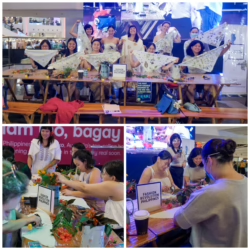
The final day of the workshops showcased the diverse facets of textile artistry. Hiwaga Hands taught participants the art of visible mending. They used techniques like patchwork, embroidery, and sashiko. These techniques breathe new life into fabrics. Meanwhile, The Art of Yarn introduced children to the world of weaving. They used a small loom. This offered a valuable lesson in the craftsmanship and dedication of local weavers.
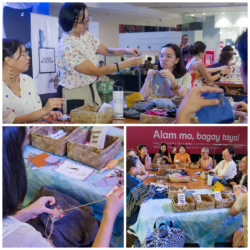
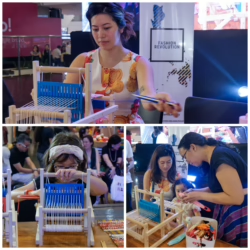
The workshops were a resounding success. Participants gained newfound skills. They also developed a deeper appreciation for the textiles they wear. Additionally, they established a connection to the rich heritage of Filipino weaving. This success demonstrates the power of collaboration. It highlights the growing movement towards conscious consumerism and ethical fashion in the Philippines. The success of this event is a beacon of hope. It inspires others to embrace sustainable fashion choices. It also encourages support for the talented artisans who bring these beautiful textiles to life.
Microfinance is based on the philosophy that even very small amounts of credit can help end the cycle of poverty. 70% of the world’s poor are women, and 80% of the world’s garment workers are women. Microfinance organisations typically lend to women, not only because they are considered a good investment as they are more likely to repay their loans, but also because lending to women brings with it a raft of social benefits for the women, their families and the wider community.
Microcredit has its advocates and its critics. Fashion Revolution will shortly be embarking on a year-long project in collaboration with MFO, Micro Finance Opportunities, and BRAC. In preparation for our work, I started to read more about microfinance and I also booked a tour with Envia in Oaxaca, Mexico so I could hear stories directly from the beneficiaries of microloans.
Advocates of microfinance include former Chief Economist at the World Bank, Joseph Stiglitz, author of Making Globalisation Work. Stiglitz sets out the importance of community involvement in development projects. He says that the microfinance model pioneered by Grameen in Bangladesh is successful because it addresses the needs of the communities which it serves. Their loan schemes work because groups of women take responsibility for each other and support one another in the loan repayment process.
But microfinance has its critics as well. Ha-Joon Chang, author of 23 Things They Don’t Tell You About Capitalism says ‘If effective entrepreneurship ever was a purely individual thing, it has stopped being so at least for the last century. The collective ability to build and manage effective organizations and institutions is now far more important than the drives or even the talents of a nation’s individual members in determining its prosperity. Unless we reject the myth of heroic individual entrepreneurs and help them build institutions and organizations of collective entrepreneurship, we will never see the poor counties grow out of poverty on a sustainable basis.’
Chang illustrates the problem with an example of a Croatian farmer who buys a cow on microcredit. This farmer has to sell the milk from the cow, even if the bottom is falling out of the local milk market and prices are plummeting because hundreds of other farmers have taken out loans and are selling more milk. It is impossible for the farmer to turn himself into an exporter of butter or cheese as they don’t have the technology, organisational skills or capital. ‘What makes rich countries rich is their ability to channel the individual entrepreneurial energy into collective entrepreneurship’ says Chang.
Looking specifically at the Mexican context, a study by Poverty Action Lab into the impact of microcredit for women in Mexico found that microcredit increased access to formal financial services which helped businesses to manage their cash flow and enabled some existing businesses to expand. However, it did not increase household income, business profitability or prompt new business creation. It was found that most of the loans made by microfinance organisations were used to make up for a shortfall in income due to unexpected circumstances such as weddings, or the need to buy medicine for a family member.
I realised quite early on in my research that not all microfinance organisations are set up as not-for-profits. Microfinance is big business in Mexico.
Institutions which started out providing affordable credit to the poor have burgeoned into large commercial institutions. The average interest rate for a microloan in Mexico is 74%, with many loans incurring 200% interest per annum. It’s no wonder that 28% of microfinance borrowers in Mexico hold over 4 loans, and 11% hold over 6 loans, often all with different microfinance institutions. Instead of helping to raise borrowers out of poverty, these loans plunge them into a spiral of debt, from which the only temporary relief is another loan to pay off the existing loans. These rates are partly the result of the decentralised nature of microcredit lending, but institutions also argue that it is because of the high risk of lending to people with no credit history.
But, are the rural poor such a high risk? Joseph Stiglitz says that Grameen Bank in Bangladesh who give small loans to rural women found they had a far higher repayment rate than rich urban borrowers.
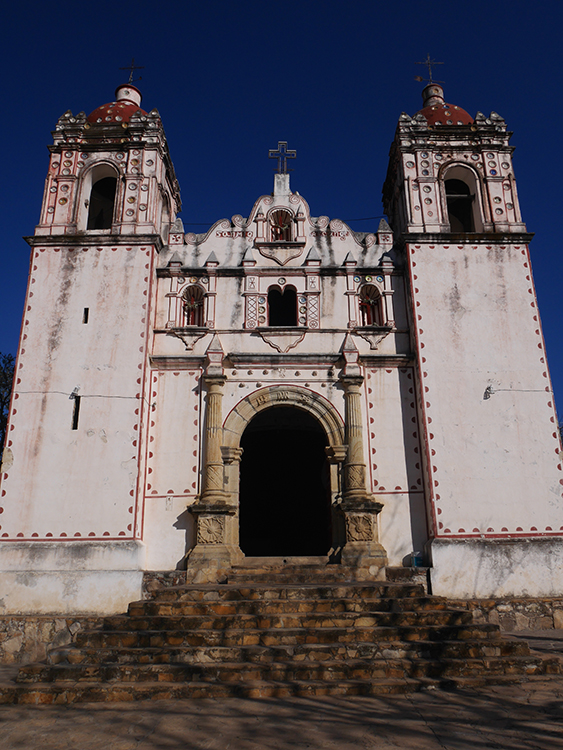
Before visiting the Zapotec community of San Miguel del Valle to meet the recipients of microloans, I asked Envia more about how they operate and what interest rate they are charging to their borrowers.
Envia was founded in 2010 and is currently run by four staff and a team of volunteers. Envia’s model is to provide interest-free loans which are funded through responsible tourism, such as the tour I took to meet the loan recipients. Envia’s tours are, in fact, the no.1 excursion in Oaxaca on Tripadvisor and certainly provide an authentic experience, as well as a unique insight the life and work of rural Zapotec women.
100% of the money raised from tours is put towards loans. Once this is repaid, the money is used for a second round of loans, and finally a third round of loans, education programmes and salaries. So the income from the tours is effectively recycled through the beneficiary communities 2.5 times. 340 women are being supported in six communities, with 2000 microloans distributed to date.
Envia lends exclusively to women as they are far more likely to invest in ways which benefit the family and, by extension, the community. As with the model in Bangladesh, at Envia the women also take responsibility for each other and in order to participate they have to form a group of three.
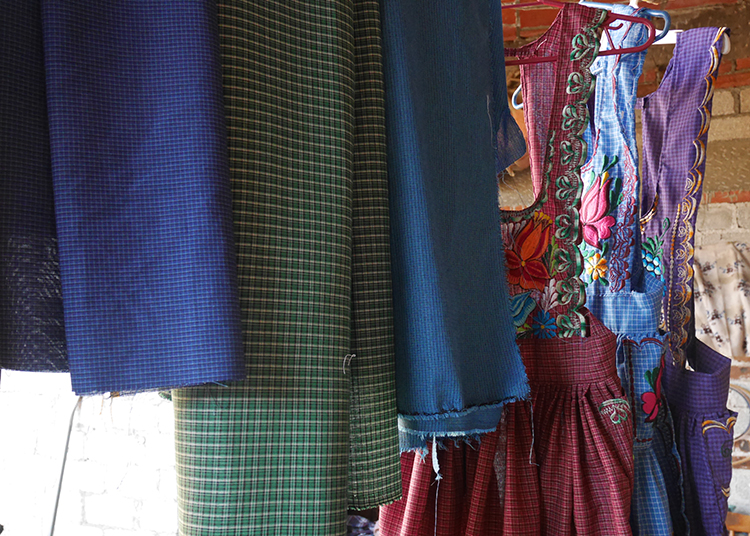
Before receiving the loan, the group of women take an eight part training course over 3 or 4 weeks within their community. This covers issues such as financial literacy, how to separate business and personal money, and how to calculate profit. Each of the three women will receive their own loan of 1500 pesos and must pay it back at either 100 pesos over 15 weeks or 150 pesos over 10 weeks. They can only proceed to the next level of loans once everyone in the group has paid back their loan. The next loan levels are 2500, 3500 and 4500 pesos and the women can decide their own repayment rate.
Women must attend weekly meetings within their communities and pay the loan back on a weekly basis. If, for any reason, they find themselves in financial difficulaties and are unable to repay their loan on a particular week, they are asked to make a minimal 20 peso contribution to show their commitment. If a woman doesn’t attend the weekly meeting, and doesn’t send her money with another member of her group, all three members of the group receive a 20 peso ($1) fine. The carrot and stick approach combining the support of group members with financial penalties clearly works well for Envia as they have a 99% repayment rate.
Another difference between the commercial microloan lenders in Mexico and Envia are the free educational programmes to help the women to grow their businesses. The women must participate in monthly business workshops which teach them about profit, promotion, PR, goal setting, branding and design. Other free classes include health, English, composting, computer skills and menopause – all of which are open to all members of the community.
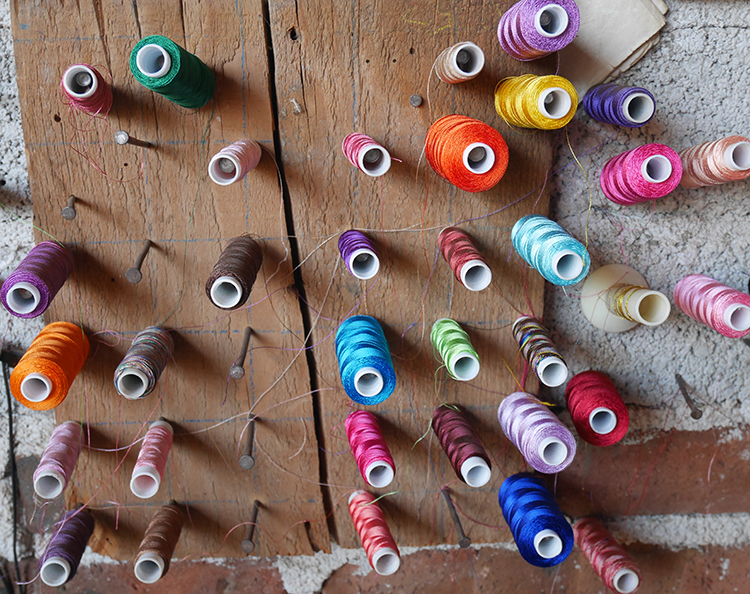
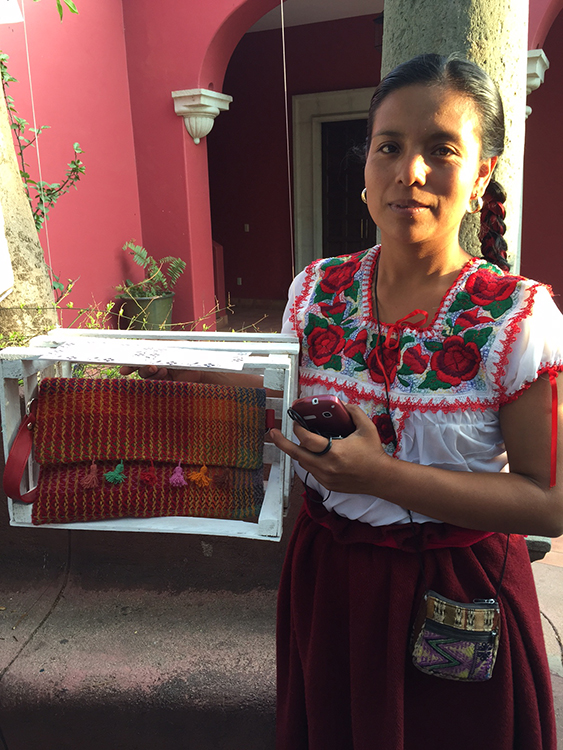
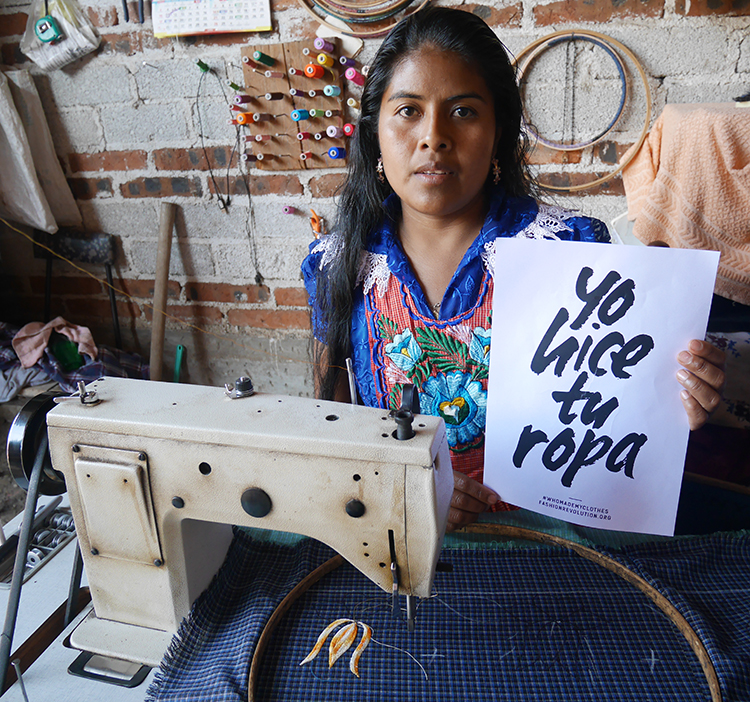
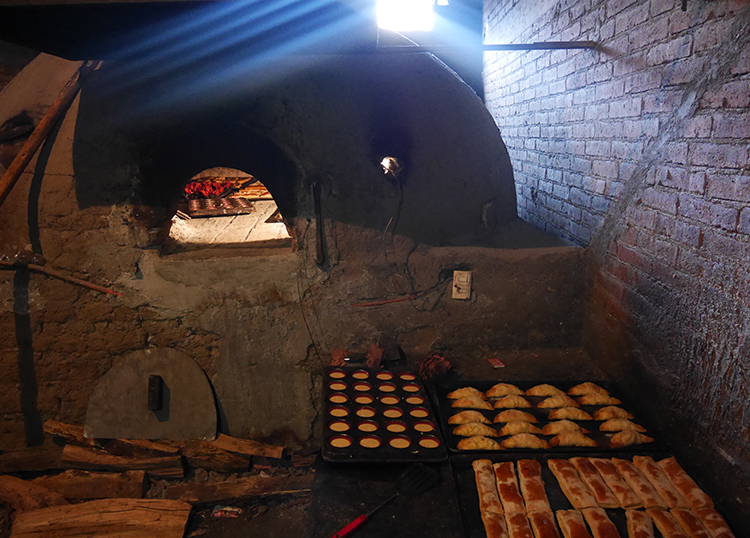
Epifania Hernandez makes aprons. She is in a group with two other women. The first runs a small restaurant in San Miguel del Valle, where I enjoyed a delicious lunch. She is using her loan to buy the ingredients she needs for the restaurant in bulk, thus reducing her costs. The second runs a bakery and is likewise using the loans to purchase ingredients in larger quantities and to visit neighbouring towns to sell her rolls and empanadas. Even though I had just finished lunch, the fresh-out-the-oven bread was impossible to resist and I bought more to take back to my apartment for breakfast the next day.
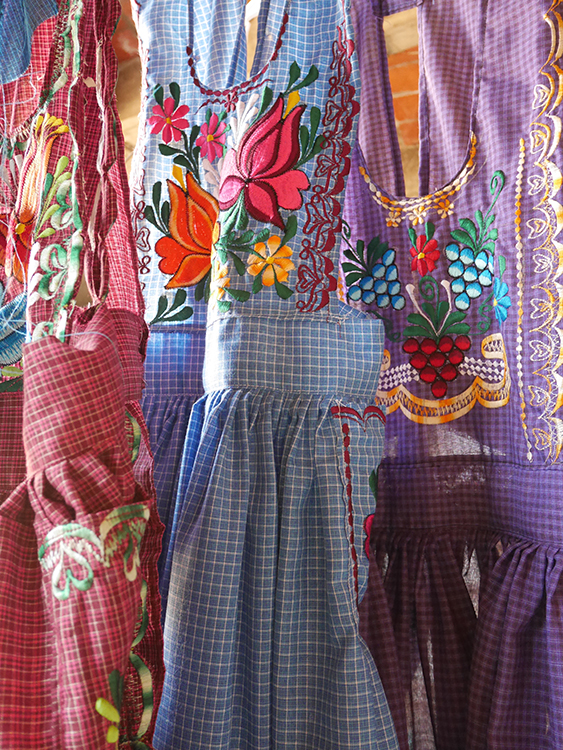
In the Zapotec communities around Oaxaca, aprons are worn every day and form an integral and practical part of traditional dress. Epifania explains that there are fashions in apron design (current hot motifs include peacocks and grapes) and there is a skill in combining apron and dress colours together.
Epifania has been making aprons for 14 years and started work at the age of 14. She wasn’t that interested in school; embroidery was much more enticing. It will take her two to three days to make and embroider each of her beautiful aprons.
Epifania has been with Envia for a year and is now on her third loan which is for 3500 pesos. She uses the money to buy stocks of fabric and embroidery threads. If she has a good stock, people can choose their colour scheme when they order aprons from her, and this is increasing her clientele.
For Epifania, and the other two women I met on the tour, microfinance was working. For all three of the women, it provided a way to expand their businesses whilst reducing their costs as the loans were used to buy raw materials in larger quantities than they would otherwise have been able to afford.
Of course, the zero interest repayment on the loans is not something which many lending institutions, even those with the most benevolent of aims, can replicate. But the high repayment rate through several loan cycles, show that these rural women can be a good credit risk and would probably continue to be a good credit risk with nominal interest rates. The coupling of microloans with business education is another important factor in Envia’s success in helping the women to build sustainable businesses for the long term.
Chang criticises micro finance as he says that, in order to grow sustainably, countries need to channel individual entrepreneurial energy into collective entrepreneurship. However, community-based model of Envia is an example of collective entrepreneurship. Although loans are given individually, the women collaborate with other members of their community and they work together, supported by the educational programme, to explore ways to expand their business and take it to the next level.
Envia was only established six years ago and the long term success of this tourism-financed business model is yet to be seen. However, from an outsider’s perspective it certainly seems to be working, both for the enthusiastic overseas visitors who have the opportunity to understand how rural women live in this region and purchase direct from the producers, and for the 340 women in the Oaxaca region who are beneficiaries of Envia loans.
Administered in a sustainable manner, microfinance can undoubtedly be a powerful instrument of social change and empowerment for women in rural communities around the world. Microfinance can help to increase women’s financial, social and emotional independence, as well as improving their status within both their families and their community.
Yesterday, in the small town of Gualaceo, Azuay, in Ecuador, the art of ikat weaving was officially recognised by UNESCO as intangible cultural heritage.
Intangible Cultural Heritage is a term used for knowledge, traditions and rituals which permeate the everyday life of a community, are passed down through generations and form an intrinsic part of their identity and culture. The skills are essential to the cultural identity of the community and the cloth is both practical and richly imbued with symbolic meaning.
Other forms of cultural expression which have already received this designation include Chinese acupuncture, Spanish Flamenco and, also in Ecuador, the art of Panama hat weaving. Whilst Material Cultural Heritage is clearly visible, the concept of Intangible Cultural Heritage is harder to understand as it embodies an art or a skill of great value to the country, often one in urgent need of safeguarding. Ikat weaving is a skill which is sadly in danger of extinction if steps are not taken to preserve it, and so its designation by UNESCO is hopefully a step to greater recognition of its importance nationally, as well as internationally.

Ikat is a Malay-Indonesian term, which is common to many cultures around the world, including Argentina, Bolivia, Ecuador, Guatemala and Mexico. Ikat is a resist technique where a resist to the dye, traditionally cabuya cactus fibre in Ecuador, is tightly wrapped around the warp before dyeing the yarn to create a pattern that will appear later during the weaving. It is a rare technique as the pattern needs to be held in the weavers head to ensure that the wrapped parts of the warp will translate into the correct pattern on the loom.
In the 25 years since I first visited Ecuador, natural dyes have all but died out in the country. On my first trip it was normal to see people dyeing wool with cochineal, indigo or nogal (walnuts). On my last visit to Gualaceo, I was delighted to see that a variety of natural dyes were still being used by the ikat weavers.

Traditional backstrap looms are still used where the weaver sits on the floor, although for textiles over 75cm in width, a foot pedal loom is often used. The pedal loom I saw in Gualaceo was cleverly constructed from old bicycle wheels!
Ikat is extremely labour intensive and requires considerable experience to memorise the complex patterns which need to be tied into the warp and which, when combined with the weft, magically transform into a pattern. According to one weaver, there are only around 15 ikat weavers left in the Gualaceo region.

In Ecuador, it is commonly known as a macana and the shawls which have long been a part of traditional dress are called Paños de Gualaceo. For centuries, the macana or paño de Gualaceo has been a key element in the traditional dress of the women in Azuay province, alongside the Panama hat, an embroidered blouse and two skirts, including an undergarment whose lower embroidered edge shows underneath the outer pleated skirt. Increasingly, I see a generational divide. In Sigsig where we work, very few young women wear traditional dress.
The three weavers pictured below are part of our Panama hat weaving association. I bought a whole roast pig for our group of 160 weavers in celebration of Panama hats being recognised by UNESCO as Intangible Cultural Heritage in December 2012.

The ikat shawl is not only beautiful and part of the rich textile heritage of the region, it is also an incredibly practical accessory. Women use it to carry their purchases home from market, or they carry their baby on their back. This mother, part of Pachacuti’s weaving association, is selecting straw for weaving her hats for the following week whilst keeping her child secure on her back.

One significant change in men’s dress in Ecuador over the past 50 years has been the disappearance of ikat ponchos, echoing the disappearance of this traditional textile technique. In the 1940s both wool and cotton ikat ponchos were worn in a traditional indigo blue and white. In the late early ’90s, indigenous Otavalan men dress underwent a Western revolution, partly due to the money pouring into the region as a result of the popularity of Ecuadorian chunky knitwear. With more disposable income, many men opted to exchange their white pleated shirt, white cotton trousers, alpargata shoes, poncho and felt hat, for jeans, trainers and a T-Shirt.
In addition to the near disappearance of ikat in traditional dress in Ecuador, its popularity has declined globally due to the prevalence on the high street of cheaper clothing with an ikat print. These garments are often called ikat by the brands who do not distinguish between a piece of cloth taking hours to weave by hand and embodying an incredible degree of skill and knowledge and a piece of cloth woven on an industrial machine.

In an article on cultural appropriation Refinery 29 recommends:
So, instead of going to a mall store and paying $7 for a cheap knock-off, go to the source. Know the story behind the piece, know the artist, what tribe they’re from, why the specific designs were used. It puts the power back in the hands of the marginalized group. Importantly, buying from a Native person or company also economically benefits the artist and the tribe, rather than a company that’s knocking off their designs.
In other word, make sure you know #whomademyclothes. Buy clothing with integrity, with a story, with a face behind it.
Hopefully the new UNESCO recognition will help to safeguard this dying skill and ensure it plays a part in the future textile heritage of Ecuador.
To find out more about intangible cultural heritage in need of safeguarding, visit UNESCO .
Burkina Faso is the biggest African cotton producer and exporter, so it is no surprise that it boasts a strong textile heritage of handwoven cotton fabric, traditionally called Danfani. Stripes are the signature style of handwoven Burkinabé fabric however artisans are able to weave complex tartan and hounds-tooth fabric designs. Preparing the design on the loom itself can involve three to seven days of work depending on the complexity of the design. Artisans can weave on small and wide looms, the latter makes the fabric more attractive commercially as fashion & design buyers can do more with this larger fabric.

In Burkina Faso, the Ethical Fashion Initiative has worked to create a cooperative which links up several weaving ateliers. The introduction of wide looms and financing of capacity building workshops has also been central to the Ethical Fashion Initiative’s work of bringing brands like Stella Jean, United Arrows and Vivienne Westwood to work with artisans in this area of the world.
In this video, Italo-Haitian fashion designer Stella Jean travels to Burkina Faso with the Ethical Fashion Initiative to meet with handweaving artisans and source fabrics with local weaving ateliers to create her SS14 collection.
Since this visit, Stella Jean has used hand-woven fabric from Burkina Faso in each of her collections.
Many women used to weave on their own account, however many gave up because it was too difficult to sell their stock and make a living from it. Joining the weaving cooperative allows them to receive many more orders, work with others and improve their skills.

Most importantly, more orders means more income for them to take control of their lives. Clémentine, a mother of three children says that since joining the cooperative she has many more orders and “this means I earn more money which improves my life and the life of my family.” Clémentine was also recently able to purchase a motorcycle which makes her independent and helps her get from work to home.

Most women use the income they receive from the orders placed by fashion houses to give a better life to their children. Mamounata says that with the income earned “I can provide for my family and keep my bike in good condition.” Joséphine is able to feed her family with the money earned and has also managed to resolve some financial issues.

Some women had no background in weaving but decided to give the craft a chance to turn their lives around. For example Véronique used to collect sand and gravel to provide for her family. However, since she joined the cooperative she states that her life has changed because “I can now pay the school fees for my children, medical costs and food. In short, I earn enough to provide for my seven children.” Augustine used to cut wood and also collect sand and gravel to sell. She says that she rushed to join the cooperative as soon as she heard of it and says that “Frankly, my life is now much better. I have six children and I can cover all their needs.”

Learning new skills is very important not only to ensure fabric is woven to high standards but also for the confidence of the women artisans. Brigitte began weaving four years ago and since has learnt many weaving skills during this time. She now feels she truly has a profession because before “I didn’t know how to do anything.” Christine began weaving two years ago and says “My life is much better than before” – she now dreams to own a bike of her own.
The Ethical Fashion Initiative is proud to work with many women weavers from Burkina Faso who have been able to improve and take control of their lives through dignified work, producing fabric for luxury fashion houses.
Photo credits: Anne Mimault & ITC Ethical Fashion Initiative
Debra Mark’os is a northern town in Ethiopia, and its beautiful land is filled with skilled artisans. It is well-known that its harder to find work in the countryside than it is in the bustling capital, Addis Ababa. As such, many will take the risk of travelling to Addis, often ending up homeless and begging. The job market in Debra Mark’os is highly competitive, and often, people will sell things – meaning they live on marginal profits due to bargaining.
However, skill-dependent jobs such as weaving can create solid job opportunities, allowing individuals to support themselves, their families and communities. Unfortunately, the weaving industry is heavily male-dominated. Women, who are already at a great disadvantage due to traditional familial pressures and lesser education, have very limited access to this sort of stable work. However, trade-advocates Sancho’s Dress hope to support women in Debra Mark’os by employing male shamanis (‘weaver’ in the local language) to train women on the hand-looms.
How does the hand-loom work? The shamani will sit behind the loom, and set his feet onto the pedals. To prepare the loom, the shamani stretches strings of cotton between two horizontal wooden poles. Then, he moves the shuttle through the material’s weft, pressing the pedals at the same time, which moves the garment forward. This ancient technology runs without electricity or complex infrastructure, making it highly appropriate in an area where power-cuts are common. The looms used to produce scarves for Sancho’s Dress are in fact made of locally-sourced bamboo and eucalyptus tree, meaning that they are easy to repair in the case of damage.
One of these Debra Mark’os shamanis is a man called Bekabil, who currently works from a small room on his land to create traditional garments. Very different to the houses in Addis, Bekabil’s home is made of wood that’s been covered in a mix of mud and grass – natural materials of the surrounding countryside. Some homes in Debra Mark’os have electricity, others don’t, and the aforementioned power-cuts may happen up to five times a week. Luckily for Bekabil, his hand-loom doesn’t require any electricity.
![Sancho's Dress 1 [Bekabil]](https://www.fashionrevolution.org/wp-content/uploads/2015/04/Sanchos-Dress-1-Bekabil-700x467.jpg)
Bekabil – who has three children – is hoping to work with Sancho’s Dress to train local women in his area to become skilled weavers, allowing him to support his own family in return. He is a amorous man who says that he is excited by the challenge of training others on a skill he learnt as a child.
The first of the women who Bekabil hopes to train is named Maaza, who lives in the same town with her family. A widow and mother of five, Maaza grew up in eastern Ethiopia. There, she learned to crotchet, and soon, her interested in clothes-making grew. Coming from a family who was separated during the Ethiopian civil war, Maaza is unique in her ability to persevere against challenges.
Over the past six years, she has learnt to sew on a pedal-powered sewing machine, creating and repairing the clothes of her neighbours. In that time, she’s also sadly seen the market for her specific skill set decline. Now, Maaza would love to learn how to weave, and even manage a weaving workshop, in order to support herself, her family, and to create beautiful garments that maintain the cultural heritage of her people.
Maaza hopes to bring other garments into production, including dresses, and for the upcoming winter, Ethiopian tartan. Through the success of the campaign and the work-shop, Maaza and Bekabil will be able to look after their respective children, which in Maaza’s case, includes putting her daughter through school.
“It’s a life-changing opportunity,” Maaza said, “We’ve prepared all the equipment, and we’ll be ready to start in three weeks’ time, which is great because for a long time now, we’ve been looking for a talented weaver, and now we’ve found one.”
Nepal is a country not only brimming with color and life but also with opportunity. It is in a small town, Pokhara, the Women’s Skill Development Organization (WSDO) thrives. The WSDO is a non-profit organization that was born out of Nepal’s rich heritage of traditional handicrafts. Started in 1975, the WSDO specializes in handcrafted cotton products. It is a completely self-sufficient organization with a purpose: providing handicraft related training and skills to underprivileged women so that they may become self-reliant.

Many of these women come from rural villages and have been widowed, divorced, handicapped, abused and estranged from their homes and villages. WSDO provides training in various areas of handicraft production such as dying, weaving, material cutting, sewing and even business management. It is with these skills that the women and their families may have a better quality of life. Today, Handwoven with Love partners with the WSDO in order to sell their survivor artisan wares to a greater global market.

The WSDO has given countless women a chance for economic independence and a renewed sense of hope. Here Chari, one these incredible women, shares her story…
Where were you born?
I was born in Khumaltar, Nepal into a farmers’ family. I was married at 14, also when I had my first son.
How did it feel being married so young?
My first husband passed away only three years after our wedding. I worked as a farm labourer to support my son until I met my second husband in 1973. Even though we both worked on the farm, it was not enough to take care of the family. In 1988, in search of better opportunity, we moved to Pokhara with my family, bigger now. I had now two sons, two daughters, and my husband who had slowly adopted the habits of alcohol. It was very difficult for me to raise my children with my only income. I had no choice but to beg. I hated begging. I also became sick but could not understand what was wrong. My husband drank and beat my children and me. Because I could not feed my family with my income my husband ignored us all.
How did that make you feel?
I was very unhappy and tried to commit suicide by jumping from Mahendra Bridge of Pokhara. I could not do it because of my children.
What happened next?
I was with my neighbor sharing my health concern and she suggested I visit the Green Pasture Leprosy Hospital in Pokhara for check up. I came to know about my leprosy after years of its attack on my body. After medication at the hospital, one day they took all patients to visit the WSDO.
How did you feel when you first visited the WSDO?
I was inspired by the organization. It provides training and a job to women.
Is that what made you decide to be a part of the WSDO?
I decided to be part of WSDO to earn money for my children and myself. I joined the organization and started weaving. My children help with the house as I weave with WSDO.
Where do you stand today?
I have managed to do everything through weaving at the organization and now can save some money too. I am 57 years old and cannot work on a farm like before. My husband died. Since being a part of the organization my life has improved a lot. I do not have to move from one place to another in search of a job. I have a job that is steady and I am grateful to WSDO for helping bring this change to my life.
What is the best part of your life today?
Being a part of the organization I get chances to travel and see different places and people. This is the most enjoyable thing. I hope to encourage and inspire all suffering women.
To learn more about and shop Handwoven with Love, visit To the Market here
With thanks to To The Market and Ashley Rose Carney, Founder of Handwoven with Love and Partner of the Women’s Skill Development Organization

This website was created and maintained with the financial support of the European Union. Its contents are the sole responsibility of Fashion Revolution and do not necessarily reflect the views of the European Union.