The Environmental Audit Committee is launching an inquiry into the sustainability of the fashion industry.
The Committee will investigate the social and environmental impact of disposable ‘fast fashion’ and the wider clothing industry. The inquiry will examine the carbon, resource use and water footprint of clothing throughout its lifecycle. It will look at how clothes can be recycled, and waste and pollution reduced.
Mary Creagh MP, Chair of the Environmental Audit Committee, said:
“Fashion shouldn’t cost the earth. But the way we design, make and discard clothes has a huge environmental impact. Producing clothes requires toxic chemicals and produces climate-changing emissions. Every time we put on a wash, thousands of plastic fibres wash down the drain and into the oceans. We don’t know where or how to recycle end of life clothing.
“Our inquiry will look at how the fashion industry can remodel itself to be both thriving and sustainable.”
The growth of the fashion industry
According to a 2015 report from the British Fashion Council, the UK fashion industry contributed £28.1 billion to national GDP, compared with £21 billion in 2009.[1] The globalised market for fashion manufacturing has facilitated a “fast fashion” phenomenon; cheap clothing, with quick turnover that encourages repurchasing.
Environmental impact of clothing production
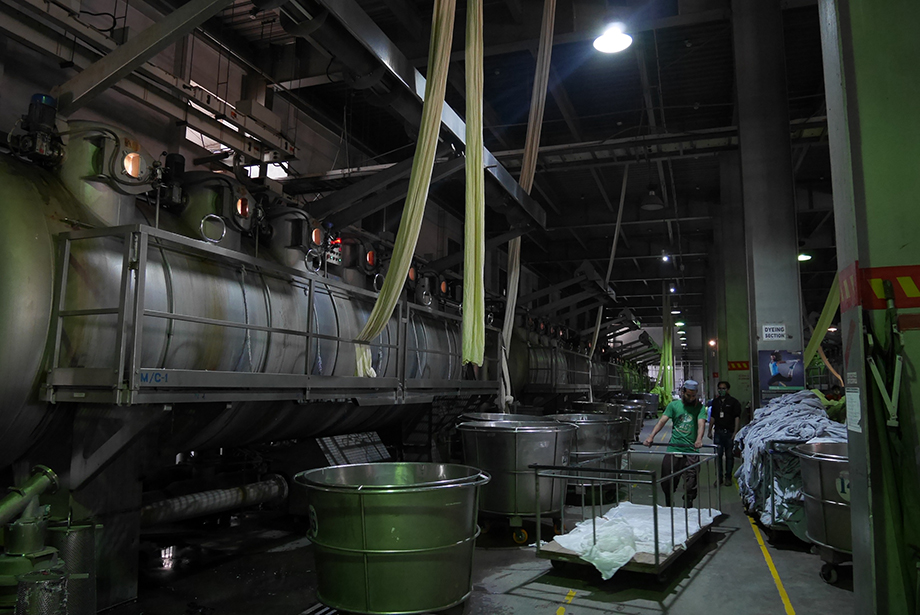
Clothing production consumes resources and contributes to climate change. The raw materials used to manufacture clothes require land and water, or extraction of fossil fuels. Clothing production involves processes which require water and energy and use chemical dyes, finishes and coatings – some of which are toxic. Carbon dioxide is emitted throughout the clothing supply chain. In 2017 a report by the Ellen MacArthur Foundation on ‘redesigning fashion’s future’ found that if the global fashion industry continues on its current growth path, it could use more than a quarter of the world’s annual carbon budget by 2050.
Environmental impact of purchase, use and disposal
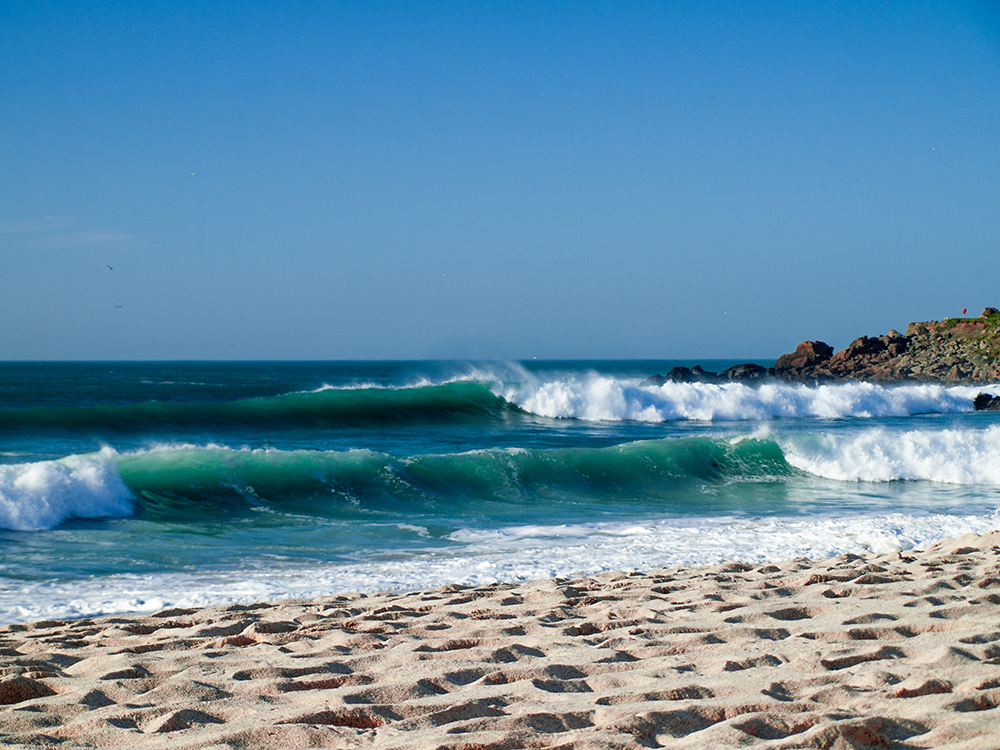
Synthetic fibres used in some clothing can result in ocean pollution. Research has found that plastic microfibres in clothing are released when they are washed, and enter rivers, the ocean and the food chain.
Sustainability issues also arise when clothing is no longer wanted. A report by the Ellen MacArthur Foundation found that the growth of clothes production is linked to a decline in the number of times a garment is worn. Clothes disposed of in household recycling and sent to landfill instead of charity shops have an environmental impact, such as contributing to methane emissions. Charities have complained that second hand clothes can be exported and dumped on overseas markets. The UK Government has a commitment to ‘Sustainable Production and Consumption’ under UN Sustainable Development Goal 12.
Manufacturing in the UK
In recent years there has been a renewed interest in clothing that has been made in Britain. However there are concerns that the need for quick turn-around in the supply chain to facilitate the demand for “fast fashion” has led to poor working conditions in UK garment factories.
The Committee will also examine the sustainability of garment production in relation to the UK’s social and environmental commitments under the UN Sustainable Development Goals. The UK Government has a commitment to ensuring ‘Decent work and economic growth’ by protecting labour rights and promoting safe and secure working environments for all workers under UN Sustainable Development Goal 8.
Terms of Reference
The Committee invites submissions on some or all of the following points by 5 pm on Monday, 3rd September 2018.
Environmental impact of the fashion industry
- Have UK clothing purchasing habits changed in recent years?
- What is the environmental impact of the fashion supply chain? How has this changed over time?
- What incentives have led to the rise of “fast fashion” in the UK and what incentives could be put in place to make fashion more sustainable?
- Is “fast fashion” unsustainable?
- What industry initiatives exist to minimise the environmental impact of the fashion industry?
- How could the carbon emissions and water demand from the fashion industry be reduced?
Waste from fashion
- What typically happens to unwanted and unwearable clothing in the UK? How can this clothing be managed in a more environmentally friendly way?
- How much unwanted clothing is landfilled or incinerated in the UK each year?
- Does labelling inform consumers about how to donate or recycle clothing to minimise environmental impact, including what to do with damaged clothing?
- What actions have been taken by the fashion industry, the Government and local authorities to increase reuse and recycling of clothing?
- How could consumers be encouraged to buy fewer clothes, reuse clothes and think about how best to dispose of clothes when they are no longer wanted?
Sustainable Garment Manufacturing in the UK
- How has the domestic clothing manufacturing industry changed over time? How is it set to develop in the future?
- How are Government and trade envoys ensuring they meet their commitments under SDG 8 to “protect workers’ rights” and “ensure safe working environments” within the garment manufacturing industry? What more could they do? Are there any industry standards or certifications in place to guarantee sustainable manufacturing of clothing to consumers?
Deadline for submissions
Written evidence should be submitted through the inquiry page by 5 pm on Monday, 3rd September 2018. The word limit is 3,000 words. Later submissions will be accepted, but may be too late to inform the first oral evidence hearing. Please send written submissions using the form on the inquiry page.
Diversity
The Committee values diversity and seek to ensure this where possible. We encourage members of underrepresented groups to submit written evidence. We aim to have diverse panels of Select Committee witnesses and ask organisations to bear this in mind if asked to appear.
Further information
- Guidance: written submissions (including information on data protection)
- About Parliament: Select committees
- Visiting Parliament: Watch committees
Membership of the Committee:
http://www.parliament.uk/business/
committees/committees-a-z/commons-select/environmental-audit-committee/membership/
Media Information: Sean Kinsey kinseys@parliament.uk/ 07917 488791
Specific Committee Information: eacom@parliament.uk/ 020 7219 6150
Committee news and reports, Bills, Library research material and much more can be found at www.parliament.uk. All proceedings can be viewed live and on-demand at www.parliamentlive.tv
Photo credits:
Houses of Parliament and Garment Factory in Bangladesh by Carry Somers
Ocean by Ross Miller
“My particular bugbear is feminist tees which were not made by women who were paid fairly for their labour. Check your tags and brands” posted actress Aisling Bea during Fashion Revolution Week.
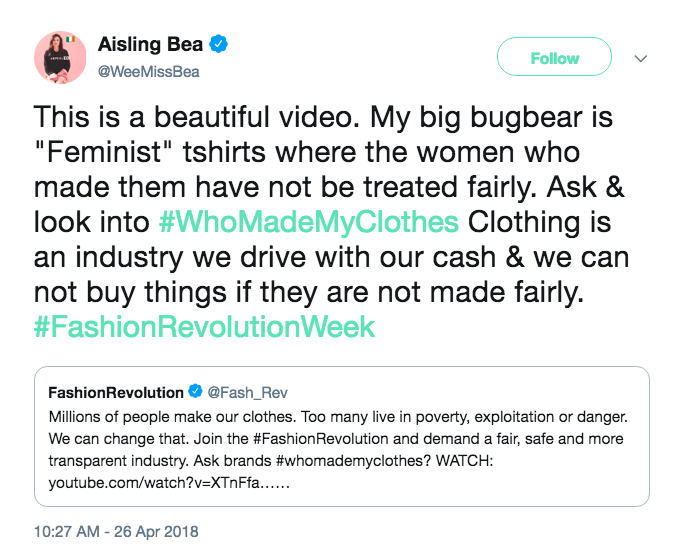
Slogan T-shirts with female empowerment messages are everywhere now, from the We Should All be Feminists T-Shirt on the catwalk at Christian Dior to the myriad versions sold in the High Street to coincide with International Women’s Day, but the reality is that the fashion industry doesn’t empower the majority of women who work in it. Gender-based inequality remains a problem throughout the industry, from the highest levels of management to the shop floor and the factory floor.
When I met with the President of the Bangladesh Garment Manufacturers and Exporters Association in November, he told me that sexual harassment doesn’t exist in garment factories in Bangladesh, whereas statistics show around 60% of Bangladeshi garment workers have suffered from sexual harassment. Earlier this week, Fashion Revolution organised Fashion Question Time at the Houses of Parliament, hosted by Mary Creagh MP. The panellists debated whether, 5 years after the Rana Plaza disaster, the fashion industry was a better place for women to work. I put forward the question ‘The #MeToo movement is inspiring, but can it ever deliver freedom from discrimination and abuse for the millions of women who work in fashion supply chains?’
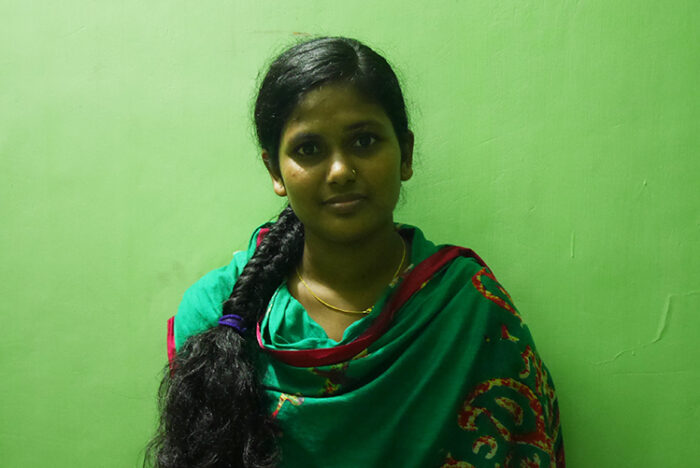
Lord Bates responded “there are two things that always work to lift people out of poverty: education for women and girls and female economic empowerment”.
Rushanara Ali MP added “we need to focus on the rights agenda as much as we do on economic empowerment to get results. We need to target our DFID aid efforts to this as mch as social and economic development. We have a female Prime Minister and I’d like to see us use our leadership globally”.
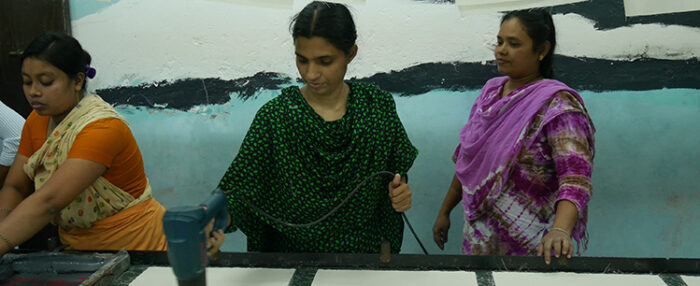
Research published this week by Fashion Revolution shows that gender-based inequality remains a problem throughout the fashion industry, from the highest levels of management to the shop floor and the factory floor. About 75 million people work directly in the fashion and textiles industry and about 80% of them are women. Many are subject to exploitation and verbal and physical abuse. They are often working in unsafe conditions, with very little pay.
Fashion Revolution’s Fashion Transparency Index 2018 which reviews and ranks 150 major global brands and retailers according to their social and environmental policies, practices and impacts, throws a spotlight on how brands and retailers are tackling gender-based discrimination and violence in supply chains. The report specifically looks at how they are supporting gender equality and promoting female empowerment, both in their own company and in the supply chain.
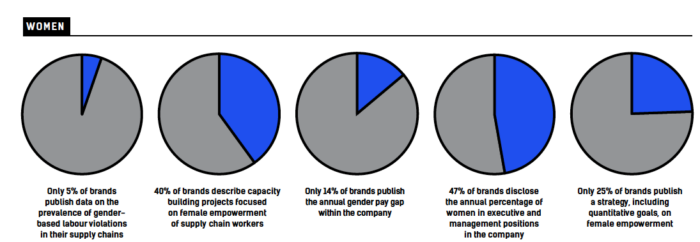
Whilst, most brands publish policies on discrimination, harassment and abuse, the research show that only 37% of brands are publishing human rights goals. Without reporting on goals and, importantly, annual progress towards these goals, consumers have no way of knowing whether their clothing purchases are really helping to drive improvements for the women who are making their clothes.
Only 40% of brands and retailers reported on capacity building projects in the supply chain that are focused on gender equality or female empowerment, while just 13% publish detailed supplier guidance on issues facing female workers in their Supplier Codes of Conduct. Only 37 out of the 150 brands surveyed report signing up to the Women’s Empowerment Principles, an initiative by the United Nations Entity for Gender Equality, or publishing the company’s overall strategy and quantitative goals to advance women’s empowerment.
Meanwhile, just 5% of brands are disclosing any data on the prevalence of gender-based labour violations in supplier facilities, such as sexual harassment and other forms of gender-based violence, or the treatment and firing of pregnant workers.
Five years after the Rana Plaza collapse, women in Bangladesh are certainly working in safer conditions as a result of factory inspections and remediation, but little to nothing has been done to make them safer from harassment, violence and abuse. Brands need to do more than sell empowering T-shirts. They need to make sure their policies are put into practice, and not just in the visible places during fashion shoots or within their company, but also in their supply chains. The people making our clothes may not be visible, but every garment they make has a silent #MeToo woven into its seams.
Sheepskins and Knitting Yarn in the Outer Hebrides, Scotland.

The shipping forecast issued by the Met office at 11:30 UTC on Friday 27 January 2017. Northwest Hebrides, Bailey – Southeasterly 6 to gale 8, becoming cyclonic gale 8 to storm 10 then southwesterly 5 to 7 later. Very rough or high, becoming rough or very rough later. Rain then showers. Moderate or poor, becoming good.

January and February are always the toughest months in the Hebridean islands off the north-west of Scotland. For both humans and animals our resources and resilience are at their lowest point, the days are short and dark, the weather extreme and wild.
However, amongst all this there is still beauty and special moments of fiery sunrises, otter tracks to the shore and soaring golden eagles.

In 2015, I tentatively started The Birlinn Yarn Company from our family croft (small holding) at Sunhill on the small Hedridean island of Berneray in the Sound of Harris. We have lived here for the past twenty years, worked, renovated two properties and brought up two sons. We now produce deep luxurious sheepskins and a range of knitting yarn from our own fleeces and those we buy from neighbouring crofters.

Hebridean sheep, dark fleeced and horned, were originally brought here by the Vikings in their long boats around 800 A.D. Overtime the long boats, built for long distance sea voyages were adapted for inter-island travel and became the Hebridean galley or Birlinn. Hence the brand name Birlinn Yarn, what’s more they are still ‘seafaring sheep’ as we take them to and fro from the islands by boat.

Supporting and maintaining traditional crofting (small scale agricultural) practice, which has maintained equilibrium and respect for the ecology for hundreds of years, is very import to our business ethos. We use seaweed to fertilise our crops, keep stock to low intensive levels and every activity or action is measured against the impact to the environment.
Our agricultural activities are set mainly by the rhythms of the weather and seasons. Our sheep lamb on the croft, then once the lambs are strong enough we take them all to the islands for summer grazing. Here they graze on a wide variety of plants, including seaweed, a bit like trying to attain our 5/day fruit and veg – resulting in a good healthy diet.
In July, we return to shear all the sheep on the islands. We choose a good forecast, wait for a crowd of cousins to come up on holiday to help out and it always turns out to be a long, hard but very enjoyable day.

In the autumn the ewes are brought back to the croft to meet their boyfriend (the tup) and then they spend the winter months grazing on the machair (raised beach) to the West of the island. And so the cycle continues …
Amongst many other activities, I am also a practicing visual artist http://www.megrodger.com with an exhibition currently showing at Taigh Chearsbhagh Museum & Art Gallery in Lochmaddy, North Uist. While my current fascination is working with the wind to generate drawings, I am always taking note of the wonderful range of colours we have in the Hebrides.
Thus, just this week, I have launched a new organically dyed knitting yarn range reflecting the subtle tones and shades of the Hebrides. Our ecosystems here are as much Highland as Island given that our habitats range from moor, to machair, shore and sea. In relatively short distances, you can encounter gliding golden eagles, wild orchids, playful otters and roaring Atlantic breakers on the shore.

This range of organic dyed yarns have been produced as a unique and small batch to complement out natural yarns. By over-dying a blended yarn this has given the colours both texture and depth. The yarns come in four colours: Sgeir – Reef, Còinneach – Moss, Monadh – Moor and Duileasg.

What next? Well, I hope this year to work with a knitwear designer who understands our ethos and brand to develop knitting patterns incorporating both the Norse and Hebridean heritage of our sheep and islands.
In the meantime, why not take a look at our website, be tempted and knit yourself a wee bit of the Scottish Hebrides.
http://www.birlinnyarn.co.uk
https://twitter.com/BirlinnYarn
https://www.facebook.com/BirlinnYarn/
Oxford Dictionaries declared post-truth to be the international word of the year for 2016. The word was chosen to reflect the politics of the past twelve months. Truth has been relegated to a bit part on a stage where politicians appeal to emotions and feelings, rather than thoughts and minds.
Fashion Revolution is a pro-truth campaign.
A poem by Sasha Haines-Stiles in Fashion Revolution’s new zine Money Fashion Power concludes:
Who embroiders truth
Who’s naked underneath
Who are you
Who are you wearing?

Illustration by Alec Doherty
For Fashion Revolution, truth means transparency and transparency implies honesty, openness, communication and accountability. Transparency means that if human rights or environmental abuses are discovered, it is far easier for relevant stakeholders to understand what went wrong, who is responsible and how to fix it. It also helps unions, communities and garment workers themselves to more swiftly alert brands to human rights and environmental concerns.
In order to create a sustainable fashion industry for the future, brands, and retailers must start to take responsibility for the people and communities on which their business depends. The factories operating in the Rana Plaza complex made clothes for over a dozen well-known international clothing brands, but it took weeks for some companies to determine whether they had contracts with those factories, despite their clothing labels being found in the rubble. Lack of transparency costs lives. It is impossible for companies to make sure human rights are respected and that environmental practices are sound without knowing where their products are made, who is making them and under what conditions. If you can’t see it, you don’t know it’s going on and you can’t fix it. Tragedies like Rana Plaza are preventable, but they will continue to happen until every stakeholder in the fashion supply chain is responsible and accountable for their actions and impacts.
This week sees the inauguration of new US President Donald J Trump. The Washington Post called him ‘the least transparent U.S. presidential candidate in modern history’ due to his failure to release his tax returns or provide evidence for the tens of millions of dollars he has reportedly donated to charity.
At Fashion Revolution, we are working on compiling the next edition of the Fashion Transparency Index which will cover 100 of the major global fashion brands with a turnover above $1.2 billion. Ivanka Trump’s brand does not disclose her financials, but we thought it would be interesting to measure her transparency against the criteria we used for the 2016 index to see how she would score. Last year we rated and ranked 40 companies based on how transparent they are. Those who are more transparent get more marks than those who are less transparent. It uses a ratings methodology, which benchmarks companies against current and basic best practice in supply chain transparency in five key areas:

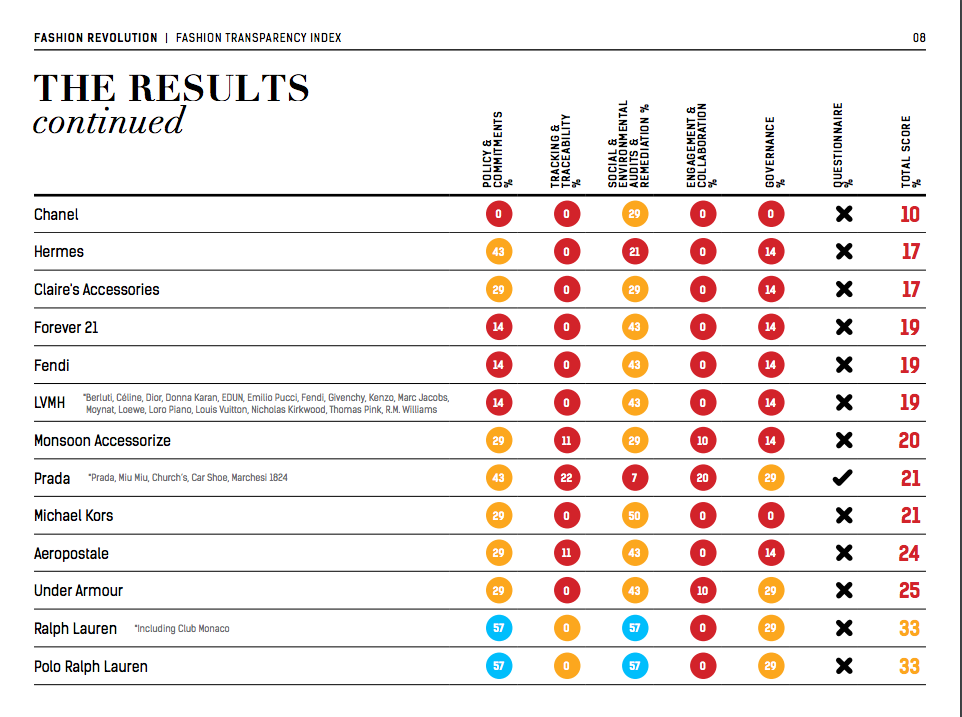
The lowest percentage scores in our 2016 index, were achieved by Chanel who scored just 10%, and Hermès and Claire’s Accessories who each scored 17%.
Measured against the same criteria, Ivanka Trump’s brand would have scored 0%. Her website discloses no information at all. Nothing.
Fashion Revolution’s mantra is Be Curious, Find Out, Do Something. We ask people to dig deeper, look for evidence, hold brands to account, ask them #whomademyclothes. The New York Times has carried out research into Ivanka Trump’s supply chain. According to a review of shipments compiled by import databases Panjiva and Import Genius, the latter of which tallied 193 shipments for the brand during 2016, her shoes and handbags are made principally in China, whilst her dresses and blouses are made in China, Indonesia and Vietnam.
Ivanka Trump’s website is post-truth. It’s not untruthful, but it appeals to the emotions of consumers to sell her clothing, rather than providing any facts. It claims to be the ultimate destination for Women Who Work, but what about the women who work for her in China, Indonesia and Vietnam? Her website contains no code of ethics, no supplier or vendor code of conduct, no sustainability or CSR report, no manufacturing list, no human rights or environmental policies. Nothing.

In the past month, critics of Donald Trump have taken to posting ironic reviews of Ivanka Trump’s Issa boots on Amazon.
On 13 December Lucinda Tinsman posted
Very narrow boots; go well with people with a narrow-minded outlook on life and actively the validity of people of diverse backgrounds from being worthy of civil rights. Because they are made of man-made materials, very difficult to breathe in. Due to the escalation of climate change they are linked to, in all likelihood the wearer will not be able to breathe at all within one generation. They are the product of pure greed, which doesn’t make any sense because even the wealthiest individuals’ children and children will die if their father’s and father’s father’s actions led to a world that cannot support human life, which is what is happening as we speak. Do not buy, for the good of the country or for the good of your children.
Susan Harper gave the boots a five star rating, explaining
The leather is perfectly conditioned with the sweat and tears of underpaid sweatshop workers, and will keep its beautiful sheen for years.
Without being truthful and transparent about how and where her clothes are made, Ivanka Trump can do little to refute disparaging comments about her supply chain. Yes, the reviews are ironic, but if Ivanka Trump had been more honest from the outset, she could perhaps have avoided significant reputational damage to her brand.
The Globescan Corporate Responsibility Radar 2016 found that transparency is a critical driver of trust in business; being seen as open and honest is the most significant driver of trust, yet consumers across the world rate the performance of companies poorly for “being open and honest.” Brands not only need to know their supply chain in detail, but this information also needs to be made available to the consumer in a way which informs and educates and starts to rebuild public trust in the fashion industry. Brands who practice transparency can help build customer trust and enhance their reputation at the same time as safeguarding the health and wellbeing of their workers and the environment.
As George Orwell said in 1984 ‘In a time of universal deceit, telling the truth is a revolutionary act’. So let’s see a revolution and let’s make transparency the word of the year for 2017.

On 24th April 2017, the anniversary of the Rana Plaza collapse, the second edition of our Fashion Transparency Index will be published. It will review and rank 100 of the biggest global fashion and apparel brands and retailers according to their level of supply chain transparency. Brands have been chosen on the basis of two factors: 1) voluntarily requested to be included; and 2) according to annual turnover, over $1.2 billion USD and representing a variety of sectors including high street, luxury, sportswear, accessories, footwear and denim from across Europe, North America, South America and Asia.
Phann is a 40-year-old garment worker living in Phnom Penh with her husband, a security guard. Their rented room is typical for a garment worker—encased by concrete walls and covered by a tin roof with one bathroom and no kitchen. Since Microfinance Opportunities (MFO) began interviewing her in July, Phann has reported working long hours, making products for major clothing brands. She has worked 61 hours a week on average, including three weeks when she worked more than 70 hours, well above the 60-hour week maximum mandated by Cambodian law. Despite her illegal hours, she is paid 66 cents an hour according to our data, falling just short of the legal minimum wage of 67 cents per hour.
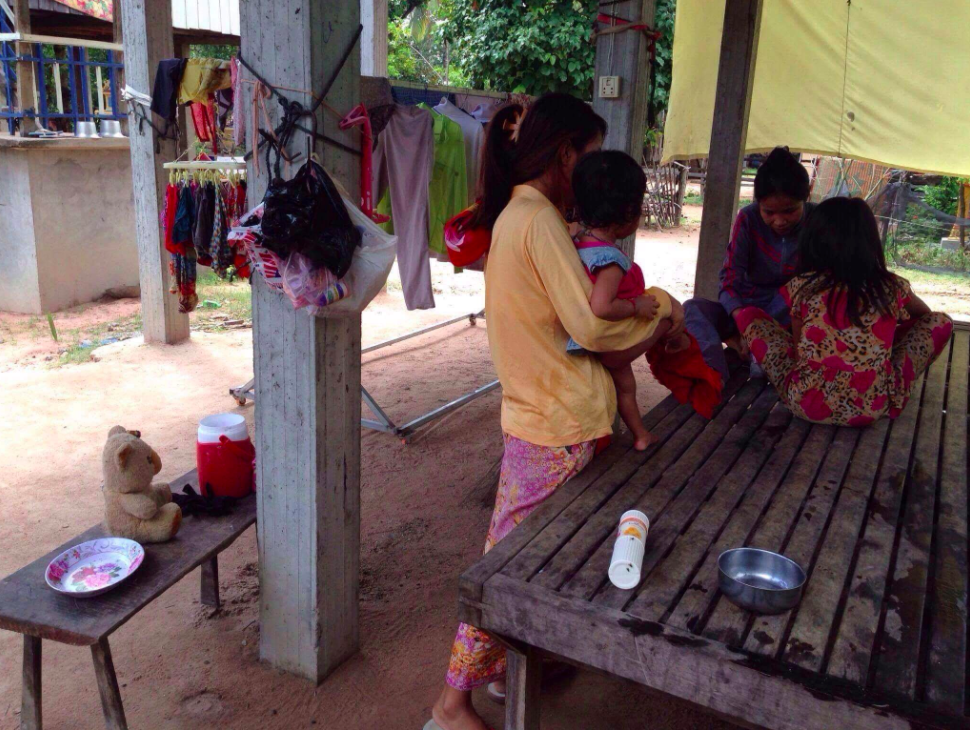
Phann, like the other 180 women participating in MFO’s Garment Worker Diaries in Cambodia, is hoping that 2017 will bring new money as the Government of Cambodia has mandated that factory owners increase the minimum wage from 67 cents to 73 cents per hour, equivalent to an increase from $140 to $153 per month [1].
Most of our diarists are positioned to receive that increase—approximately 68 percent report earning the minimum wage, if not higher. The other 32 percent of workers stand to be disappointed, according to a preliminary analysis of the data. They earn only 57 cents an hour on average, so far below the minimum wage that an almost 30 percent increase in their wages is unlikely.
Not only are they receiving less than the minimum wage, but the ways in which their earnings are calculated are often opaque, and their payment schedules are inconsistent. For instance, Mao—a 28-year-old garment worker living in Phnom Penh—received checks showing that she earned the minimum wage. During our first interview, she reported that the factory paid her $140, but she could not tell us how many hours she worked during the pay period. At that moment, we were hopeful she would be one of the garment workers who received fair wages for her work. Her next check was for $137.50, but she worked 250 hours during the pay period which equates to only 55 cents an hour. She fared better on her next paycheck, earning 68 cents an hour for 227 hours of work. However, by the time she received her fourth check, any pretense that she was receiving fair wages had disappeared. She earned $90 for 200 hours of labor, equal to 45 cents an hour.
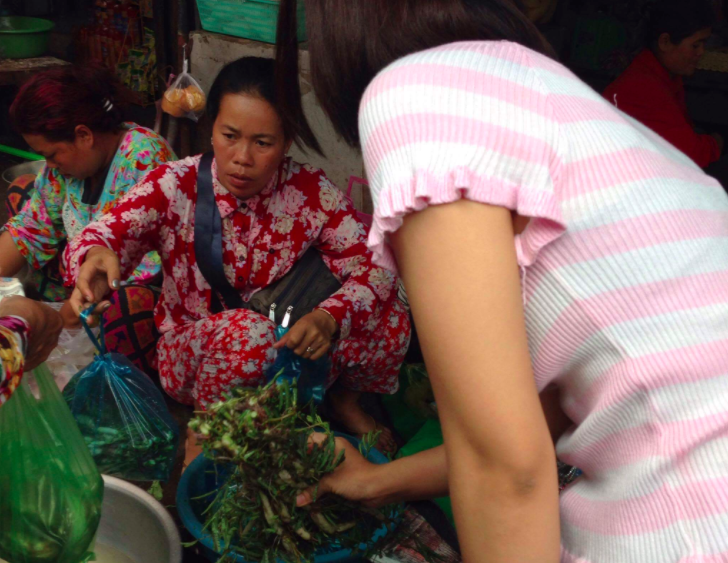
At least Mao’s employer paid her. Chen, who works in another factory in Phnom Penh, worked 194 hours but was never paid as her employer absconded. She and her colleagues did everything possible to stop him: they attempted to block the exits to the factory to prevent his escape and sought a court order to detain him, or at least seize the assets of the factory, but those efforts proved unsuccessful. As of this writing, she has still not received any compensation for her work.
For women like Mao and Chen, and women like Phann who are paid fairly but work in excess of what is allowed by law, an increase in the minimum wage will not be enough to ensure their dignity. Brands and the Government of Cambodia must enforce the regulations that ensure fair wages and working conditions.
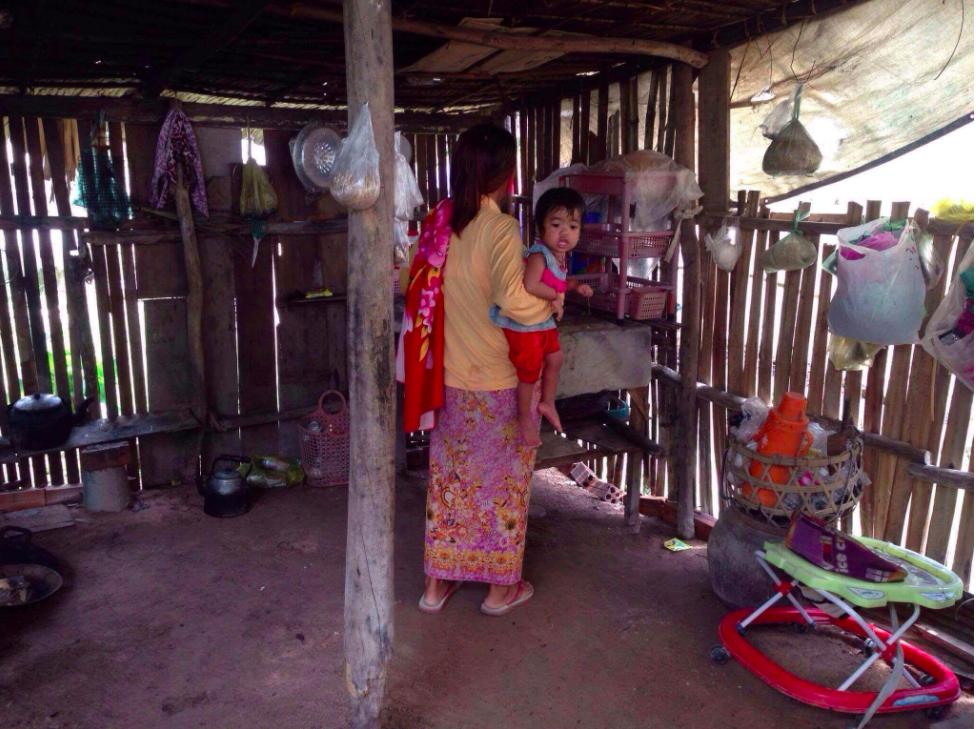
There has been slow progress in this regard, and a lack of transparency in the supply-chain makes evaluating the pace of progress difficult. Organizations like the Solidarity Center and Human Rights Watch are investigating working conditions to bring better transparency to the sector, but their main leverage point is to indict the reputation of the brands, a real but indirect threat to brands’ bottom lines. Consumers, with their ability to directly impact brands’ by altering their purchasing patterns, are the ultimate leverage point. For change to occur, you as consumers must demand transparency and fairness throughout the supply-chain.
To ensure dignity for these women, you must demand a fashion revolution.
[1] The legal minimum wage in Cambodia is $140 per month and is not typically reported as an hourly rate. The legal regular work week, before earning overtime, is 48 hours per week. For an average month, this equates to 67 cents per hour. The government has set the minimum wage in 2017 at $153, equal to 73 cents per hour.
The Garment Worker Diaries is a yearlong research project, led by MFO and supported by C&A Foundation, which is collecting data on the lives of garment workers in Bangladesh, Cambodia, and India. Fashion Revolution will use the findings from this project to advocate for changes in consumer and corporate behavior and policy changes that improve the living and working conditions of garment workers everywhere.
By Allison Griffin for Remake
Few things are more powerful than a room full of women who have something to say.
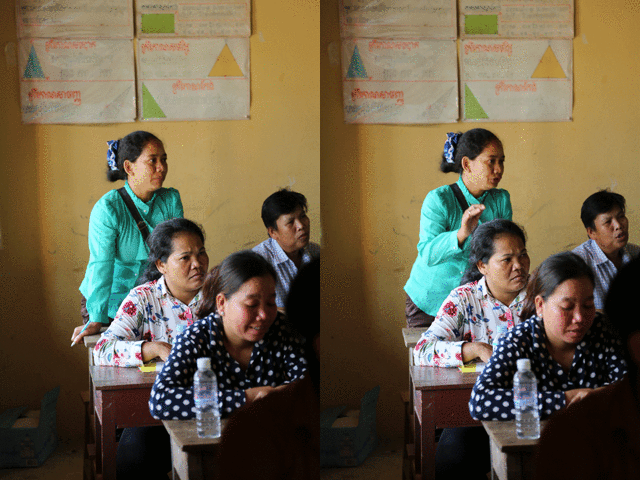
As part of our Remake Journey we traveled 2 hours outside of Phnom Penh along dirt roads to a small school in the middle of rice fields, one of the few safe places makers are able to unite to talk about their rights without the police breaking up the meeting.
This gathering was hosted by Solidarity Center, to help makers fight for their rights. We learned that when big factories agree to cheap prices and tight deadlines, they often can’t meet these demands. So they ship orders off to fly by night operations–dark, dingy subcontracted factories where the conditions are the worst.
The women we met had sneaked out labels from the brands they illegally sew for including Zara, H&M and Tommy Hilfiger. It was dangerous for them to sneak these photos and labels out but they did it anyway, in the hope that we and you as readers would help them, to ask these brands pressing questions about why they worked such long hours for so little.
I had the honor of sitting down with one such maker, Char Wong. This is her story:
I grew up in a family of eight children raised by a single mother. I was a farmer before working in a subcontracted garment factory. I found work in a subcontracting factory to earn more money and provide a better life for my own family, but the pressure from the daily quotas is stressful and the money is not enough.
I support my 16-year-old son, 10-year-old daughter, my elderly mother, along with my husband who is a farmer. I struggle to feed everyone with the minimum wage and extra $2.50 a day that I earn. My mother has diabetes and her medicine costs $30 a month, over 20 percent of my monthly income. I also want to save money for my children’s education.
wanted a better life for myself and my family which is why I took this work. But life has become harder. I get paid per 12 pieces, but if there’s even one single error in the batch, I don’t get paid at all.
A few years ago, the factory would receive an order for a new design every two or three months, but with the new fast fashion cycles, it now gets more and more new designs in a shorter amount of time. Learning complex designs is very difficult and we get no training. Sometimes it takes two or three hours just to learn and the factory supervisor scolds us for any mistakes. The more time it takes to learn a design, the less time I have to meet the quota and the less money I make. I typically make $5 a day, but with the more complex designs, I only make $2 a day.
Sometimes I cry because I fear I won’t meet the quota and get paid.
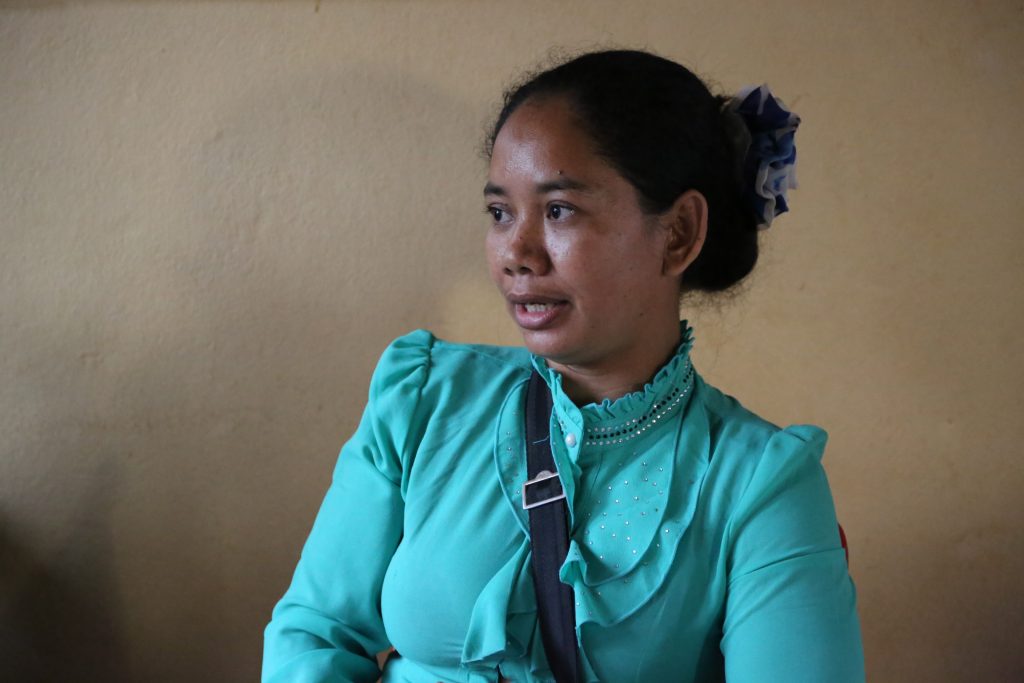
Like most parents from all corners of the world, I want a better future for my two children. I hope to pay for their college education so that they can work in Cambodia’s government. Government jobs pay well and do not require hard physical labor. I hope that my children can be government leaders and help improve the conditions and rights of future garment factory makers, just like myself.
I am grateful for organizations like the Solidarity Center, who teach us about our rights. I am learning to speak up more. I want my story and my colleagues’ stories to spread to people throughout the world.
You being here, listening, makes me hopeful.
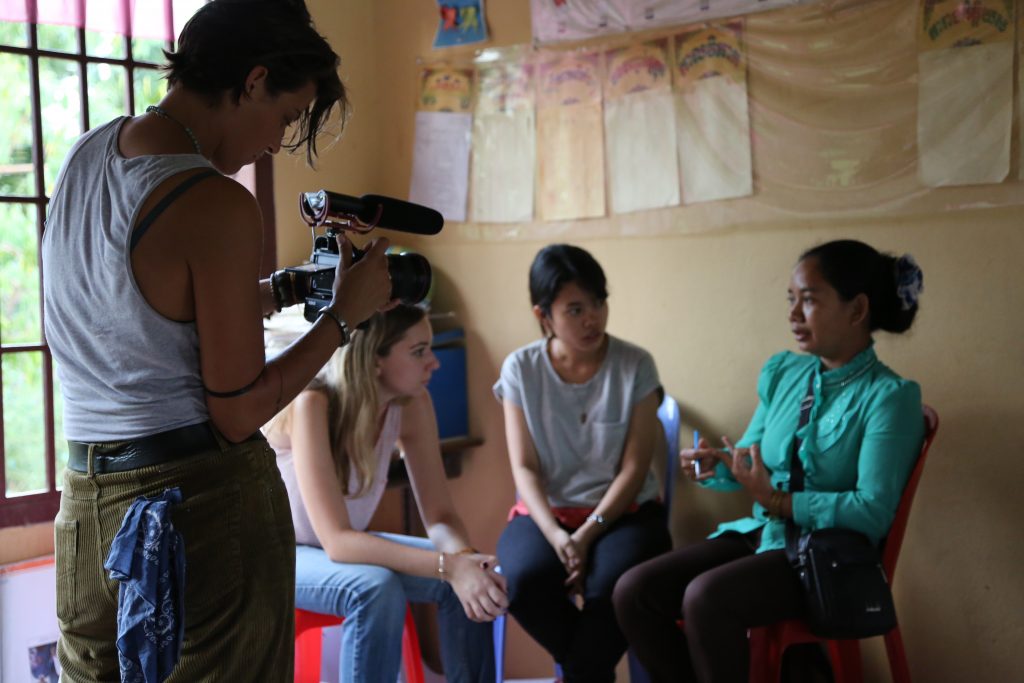
I definitely felt a lot of girl power throughout the day, both from our own all female crew and the makers we met. These women are not playing victims, but fighting for their rights and educating themselves on their rights. Speaking with Char Wong, I realized that the hopes she has are fundamentally no different from mine–for a fulfilling life. I hope as a designer, I can be a part of the change and that this story moves you to buy better. Together we can #remakeourworld.
Fashion design schools have an allure. Many young women in their early twenties get fashion degrees hoping to launch their own lines and drive the aesthetic of a camera-ready $3 trillion industry.
In reality, they enter a competitive market, applying for entry-level design positions in expensive cities. If accepted, they will work long days, under tight deadlines and fluorescent lights, all for salaries as low as $30,000. These graduating designers have little choice but to dive in and hope for a better future.
Interestingly enough, overseas, where roughly 97% of our clothes are made today, there are also young women in their early twenties toiling away on the assembly line. Their wages are low, working hours long, and conditions often difficult. And yet, for these young makers, factory jobs also represent hope for a better future.
Today we buy more clothes and yet somehow pay less for them. This phenomena called fast fashion, much like fast food means the industry cuts corners. What started as a way for more of us to look good on a budget has resulted in a rise in cheap, chemical filled clothes, brought to us by human hands forced to work longer hours for low wages.
But this article isn’t about shaming the fashion industry for building a broken business model. It’s about linking the amazing women on either end of the supply chain – designer and maker – to come face to face, woman to woman, to create a more human centered fashion industry.
80% of the people who are making our clothes are women, usually just 18-24 years old. Their hopes and dreams match ours: to be happy, healthy and see the world. At Remake, we pass the mic back to the women hidden at the other end of the supply chain. We have traveled to Haiti, India, Pakistan and China, to ask her to share her stories.
Our recent Remake Journey to Cambodia was in partnership with Levi Strauss Foundation and Parsons School of Fashion, home to fashion icons such as Donna Karan, Alexander Wang and Tom Ford. We took three of Parsons’ amazing graduating designers:
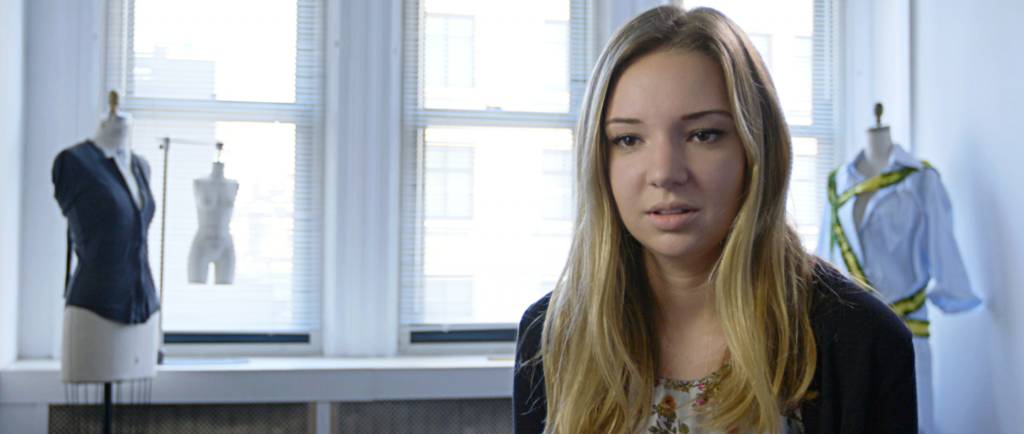
“As a fashion designer, we are so distant. A lot of our industry uses makers oversees and are so disconnected from them, but these are the people who are creating our work and our designs. So meeting with them and having that more manifested in our heads is a connection we need to be thinking about more.”
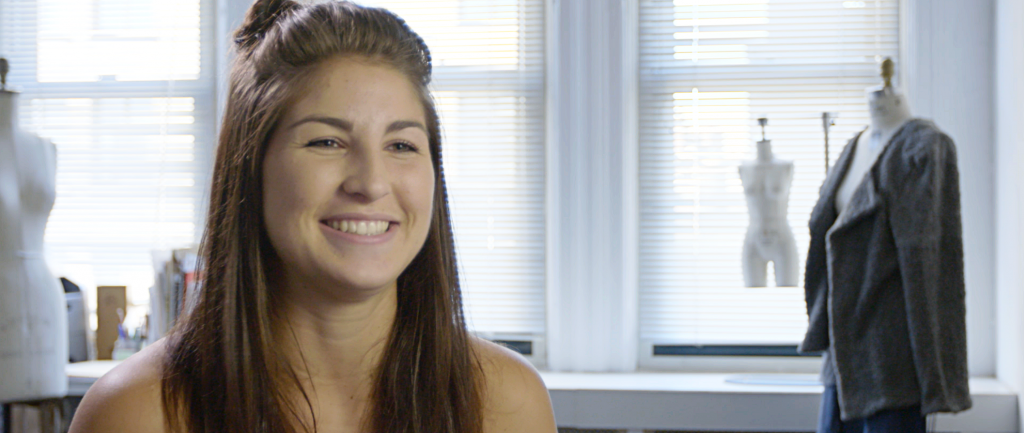
Meet Allie Griffin, whose great grandmother used to make our clothes right in NYC’s old garment district. Coming to a prestigious school like Parsons and recently interning at Oscar de la Renta, she feels that in one generation her family has come full circle from maker to designer.
“Fashion effects economies, politics…something you don’t normally think about. But at the end of the day there are people making our clothes, human lives depend on these jobs. That’s why fashion is important to me.”
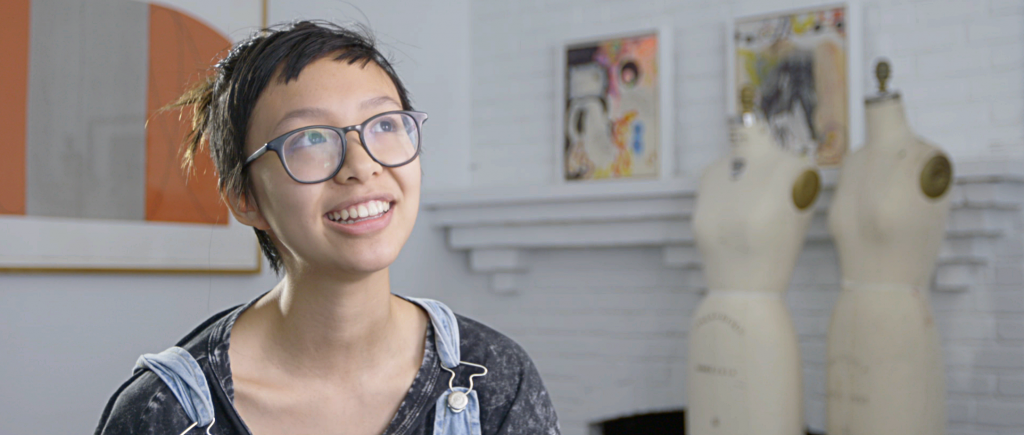
Meet Anh Le, who designs menswear and has recently interned at American label Thom Browne. Her parents came as refugees from Vietnam, where her family worked in the garment industry. As an Asian aspiring designer, she wants to do right by creating clothes that are ethical and respect the maker.
“I’m really interested in being part of this new generation of fashion designers. We are interested in finding ethical and sustainable ways to participate in fashion. There are a lot of problems that I see, like low wages, underage workers, poor working conditions. I know a lot of my fellow students and I think it’s time to change how we make fashion.”
Meet Casey, who has designed future forward collections in collaboration with Tide and Intel. She is deeply interested in creating more sustainable patterns and textiles in union with factory systems.
Day 1: Tonlé: Zero-Waste Fashion
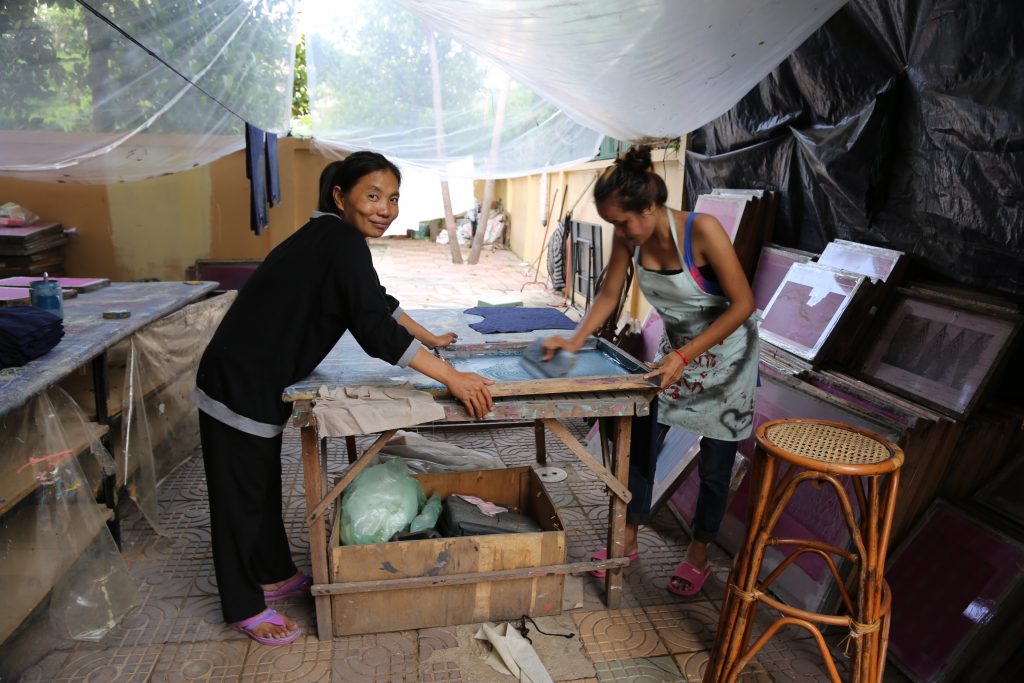
We visited Cambodia’s first zero-waste brand Tonlé to experience the power of fashion as a force for good. Tonlé provides at-risk women with a living wage, health care and good working hours, while also being good for our planet.
“From the moment we stepped inside the gate you could feel it, it was such a special place. There were a group of women at tables in the front yard knitting together, and they welcomed us warmly with smiles,” recounted Casey. “I spoke with Ny, a transgender male who is in charge of stock and shipping.”
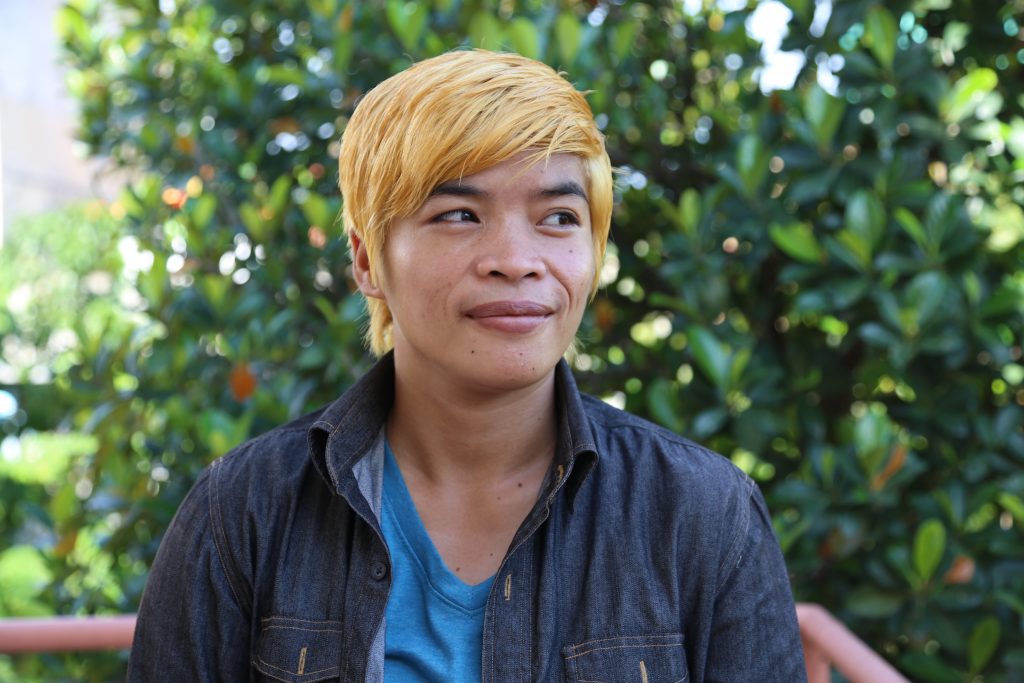
“I think about how the clothes we make go all over the world. I also think that the people who buy from Tonlé really care about us, the people who make them. Most of the makers in the clothing industry come from really poor places, and they work so hard to try to achieve better lives. I want there are more brands like ours so that there are more people who have jobs as good as mine.” – Ny
Day 2: 2,000 People Making Our Jeans
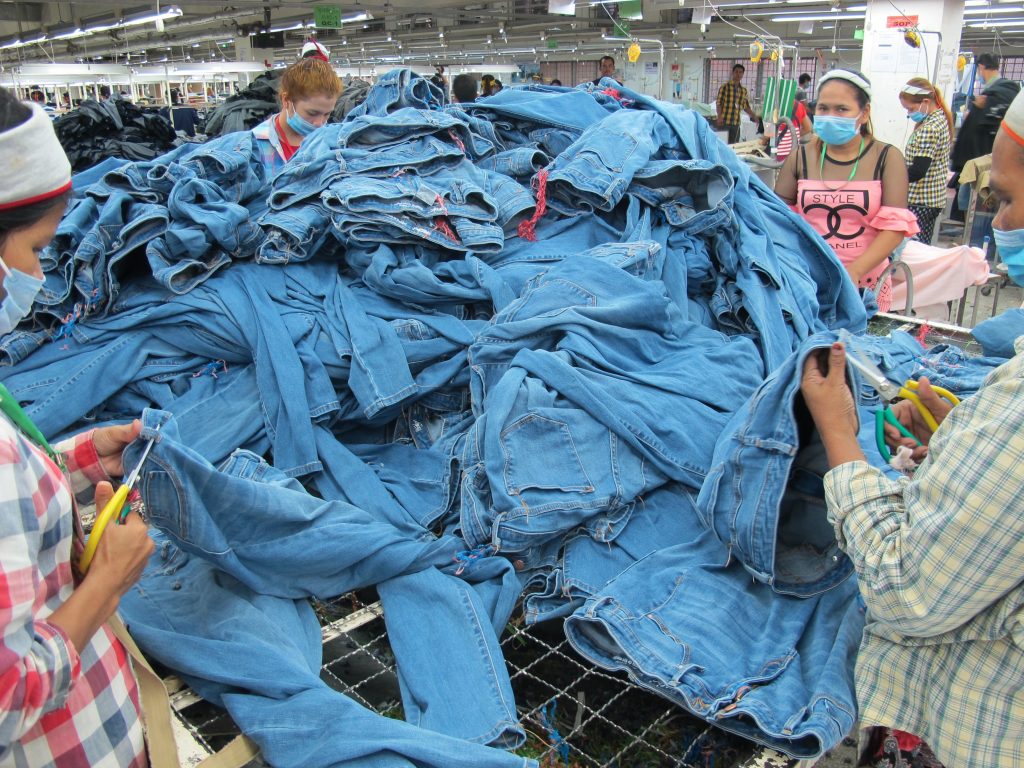
We traveled down a winding bumpy and dusty road to a denim factory on the outskirts of Phnom Penh where jeans are made for every imaginable brand: from JCPenney and Kohl’s to Simply Vera by Vera Wang and J Lo.
Walking down the assembly line, you see hundreds upon hundreds of women, heads down doing fast repetitive motions, backs crunched just like ours over laptops. The sheer volume of stuff, and noise from the machines was overwhelming. All in our quest for cheap jeans.
The denim distressing unit was especially eye-opening.
“All the cuts, wear marks and washes are done by human hands, and these tasks are clearly physically demanding and even dangerous, from all the spraying of harsh chemicals. As soon as our tour ended my brain was overwhelmed with what I had just seen; how could one pair of jeans sell for $20 and have had so many hands work to produce them; the math behind where the money goes does not scream fair at all.” – Casey
That evening one of the denim makers invited us to her home for dinner in a nearby slum. We traveled in the open air truck with her, where passengers need to balance sitting on both ends to ensure the truck did not topple over. Makers in Cambodia have lost their lives in trucks just like this one, which thousands use to get to work everyday.
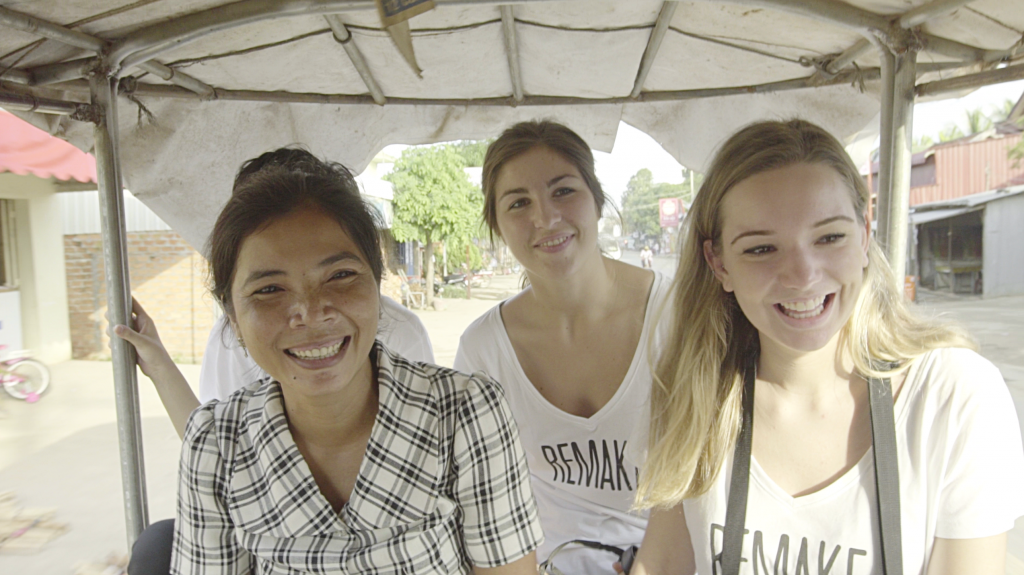
“I started working when I was 15. Since then I’ve worked at several different factories. My husband is sick, so my $140 a month salary support’s my whole family. I work at the factory all day and then work a second job as a tailor at night. I want my daughters to learn English and go to a school like Parsons. I’ve actually seen New York on TV and maybe someday I can come visit. I want young designers to know about my life. I have suffered but I feel stronger having met my sisters from NYC.” – Sreyneang
Sreyneang’s home was no bigger than two dining tables pulled together, the floor just dirt and the roof sheet metal. Her husband, children and neighbors all crowded in to meet us. Her home may have been small but her heart was huge. When we sat down to eat together, she kept offering us bottled water she had bought for us and took only two spoonfuls of rice. Insisting that we, her neighbors and even the stray dog and cat that stopped by had something to eat first.
“A truly inspiring, loving, and kind soul, I haven’t stopped thinking about her and I don’t think I ever will.” – Casey
Day 3: Sub-Contracted Factories, The Most Invisible People
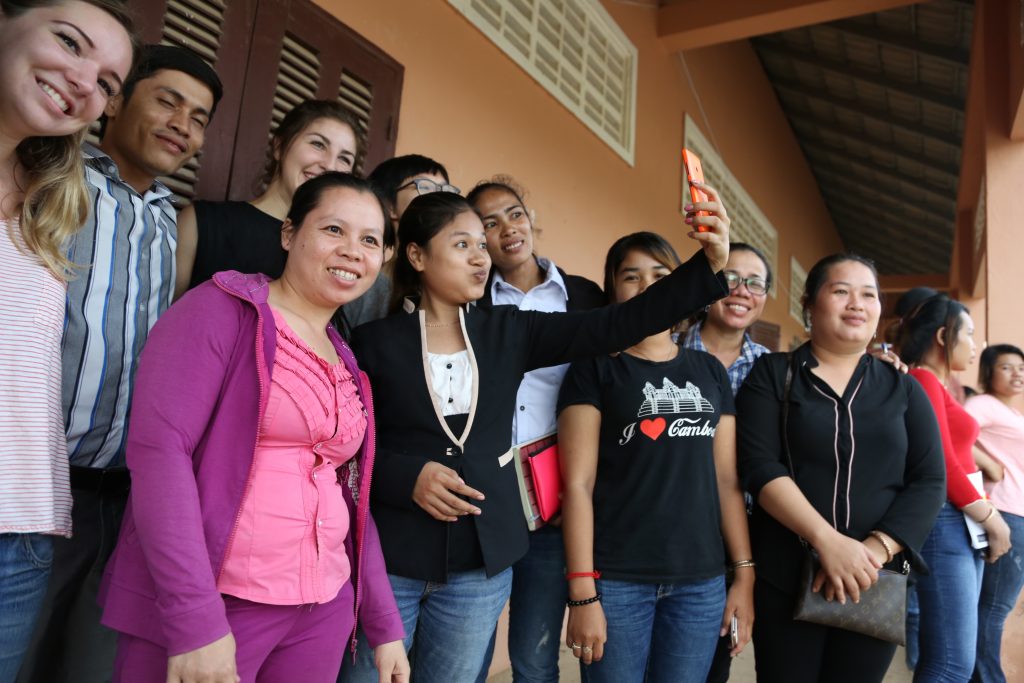
Few things are more powerful than a room full of women who have something to say. We traveled 2 hours outside of Phnom Penh along dirt roads to a small school in the middle of rice fields, one of the few safe places makers are able to unite to talk about their rights without the police breaking up the meeting.
This gathering was hosted by Solidarity Center, to help makers fight for their rights. We learned that when big factories agree to cheap prices and tight deadlines, they often can’t meet these demands. So they ship orders off to fly by night operations–dark, dingy subcontracted factories where the conditions are the worst.
The women we met had sneaked out labels from the brands they illegally sew for including Zara, H&M and Tommy Hilfiger. It was dangerous for them to sneak these photos and labels out but they did it anyway, in the hope that we and you as readers would help them, to ask these brands pressing questions about why they worked such long hours for so little.
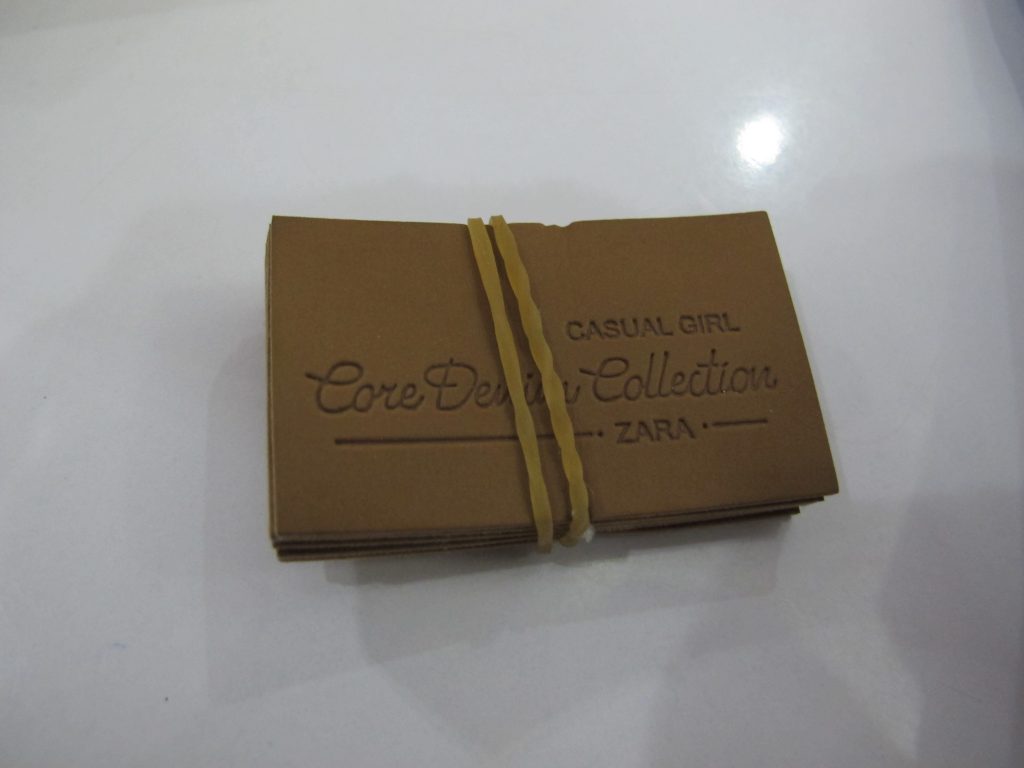
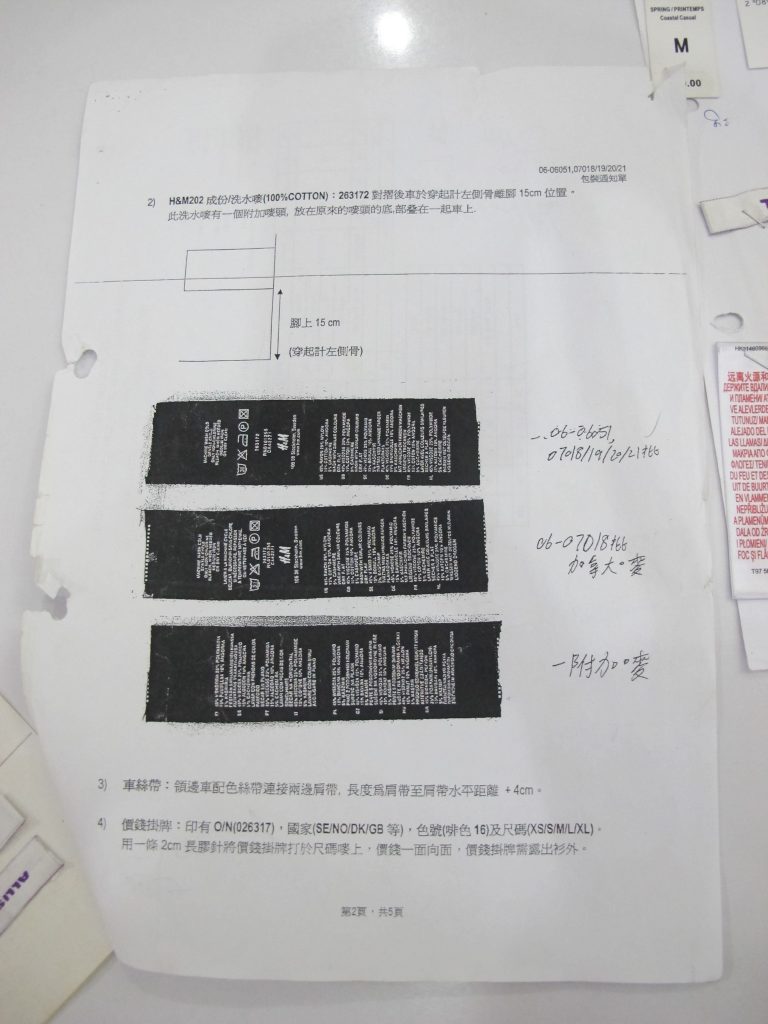
Some of these women made less than a $100 a month despite working all day long. Others noted that they were forced to take pregnancy tests and if it was positive, they were fired.
We learned that some factories pop-up during holiday rushes, then shut down to avoid paying the makers anything once the order is filled. Some of these women had been sleeping outside factories to get their back wages to afford food and rent. One of Solidarity Center’s incredible staff leaders Somalay, said to us,
“We will never stop. We will fight.”
She cares and risks her life, because she’s been there, she used to be a garment maker herself.
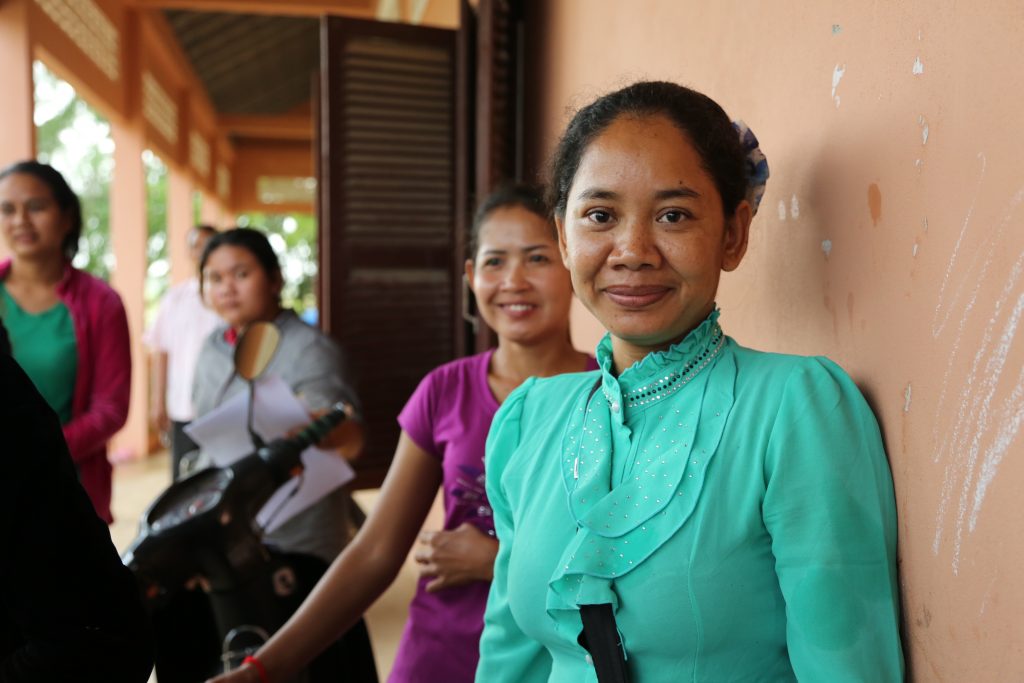
“I wanted a better life for myself and my family so I took this work at a subcontracted factory. But life has become harder. I get paid per 12 pieces, but if there’s even one single error in the batch, I don’t get paid at all. I used to make a new design every 2-3 months. Now, it’s two to three new designs per month. The designs are more complicated but we get no training. It’s harder to meet the quota. Sometimes I cry because I fear I won’t meet the quota and get paid. I hope you will help me and my colleagues by spreading our stories to the world. You being here, listening, makes me hopeful.” – Wong Char
“I definitely felt a lot of girl power throughout the day, both from our own all female crew and the makers we met. These women are not playing victims, but fighting for their rights and educating themselves on their rights. Some of the makers dressed up in professional attire, including blazers and heels and every person had a pen and paper they were furiously taking notes with. Speaking with Wong Char, I realized that the hopes she has are fundamentally no different from mine–for a fulfilling life.” – Allie
Journey #5 ended with see-you-laters, not goodbyes. Our designers and makers became friends on Facebook WhatsApp and promised as sisters to keep in touch and fight together to make fashion a force for good.
It takes 100 pairs of hands to bring each of our clothes to life. Next time you go shopping, we hope you think of Ny, Sreyneang and Wong Char and their dedication to our fashion.
We hope you join our movement and buy better from brands like Tonlé. Together we can #remakeourworld
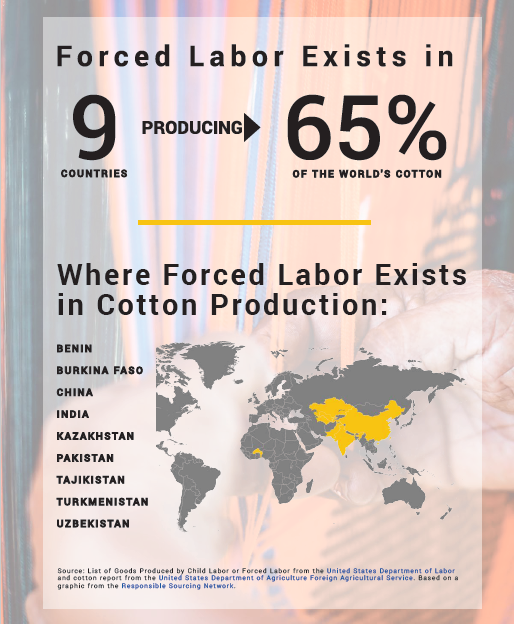
KnowTheChain have launched a ranking of 20 large clothing and footwear companies on their efforts to eradicate forced labor and human trafficking from their supply chains. Their Apparel & Footwear Benchmark Findings Report found only a small group of companies seriously addresses exploitation. Most companies have systems in place to monitor and react to forced labour and human trafficking, but few companies address systemic causes.
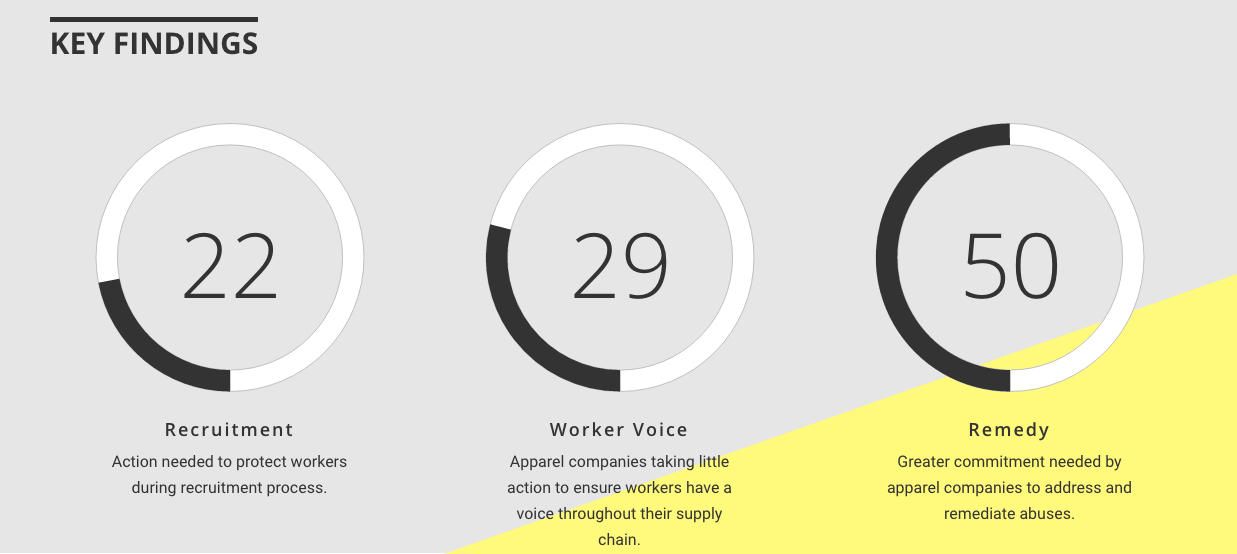
The four highest performing companies (Adidas, Gap, H&M and Lululemon) achieve scores above 60/100. Among the lowest performing companies are Hong Kong-based Belle International Holdings (0/100), Chinese clothing manufacturer Shenzhou International Group Holdings (1/100), and the luxury Italian fashion house, Prada (9/100). Across seven measurement areas, the average company score is 46 out of a possible 100. Overall, luxury brands including Hugo Boss, Kering (holding company of Alexander McQueen, Gucci, Stella McCartney and others) and Ralph Lauren score much lower than high street apparel retailers (such as H&M, Inditex or Primark), with none achieving an above average score.
This echoes the findings of Fashion Revolution’s Fashion Transparency Index, published in April 2016, where Prada, Ralph Lauren and other luxury companies received some of the lowest scores.
Longstanding public awareness and pressure, spurred from incidents of child labour in the footwear sector in the 1990s and grave health and safety incidents in Bangladeshi factories in recent years, has resulted in companies putting in place supply chain monitoring systems. However, these have a strong focus on first tier suppliers, while workers tend to be at the greatest risk further down the supply chain. Adidas, which ranked highest in the benchmark (81 out of 100 points), works in partnership with its first tier suppliers to support training for second tier suppliers and subcontractors, as well as develops models to address risks of forced labour in its third tier supply chain.
Forced labour in this sector occurs both at the raw materials level and during the manufacturing stages of apparel and footwear companies’ supply chains. The report finds that all companies benchmarked can improve in rolling out programmes that reach to all tiers of their supply chains. Companies are encouraged to promote direct hiring of workers where possible as well as to perform robust due diligence of third-party recruitment agencies. Companies are also encouraged to engage directly with supply chain workers outside the factory context, allowing companies to get a clearer picture of what is happening on the ground.
“Despite international and brand attention on worker issues for more than twenty years, many retailers haven’t addressed the deep seeded causes of worker abuse in their supply chains. Hopefully this benchmark will help them recognise that they need to do better by the people making their clothes and shoes,” said Killian Moote, director of KnowTheChain.
We can all put pressure on brands to address forced labour and other issues by asking the question #whomademyclothes as transparency is an essential first step towards improving conditions in the supply chain. Use the pledge at the bottom of Fashion Revolution’s home page to send a tweet to your favourite brand.
Fashion Revolution’s theme for 2017 is Money Fashion Power which will be exploring the flows of money and structures of power across the fashion supply chain.
“There is nothing more important than performance, and fashion brands have to perform because of this greed – not a percent or two per year, but at least 10 percent quarterly, even when we’re talking about billion-dollar businesses. There is no end to the greed, so the brands are spreading themselves thin”
said trend forecaster Li Edelkoort in an interview with Deutsche Welle published this week.
Tomorrow is the fourth anniversary of the Tazreen Fashions fire in Dhaka Bangladesh. All of the garment workers were on an overtime shift to complete an urgent order when the fire alarm sounded, but managers ordered them to carry on working. As the smoke and fire spread through the building and workers eventually tried to escape, they found that iron grilles barred the windows and the collapsible gate was locked. None of the fire extinguishers appeared to have been used which suggests workers had not received fire safety training. 112 workers died and more than 200 were injured. The official who led the inquiry into the fire said
“Unpardonable negligence of the owner is responsible for the death of workers.”

After the Tazreen fire, factories were told to replace collapsible gates and lockable doors with fire-proof doors so there was always a safe exit point in the event of a fire. In the Bangladesh Accord’s initial inspection of 1600 garment factories, it was found that over 90% had lockable, collapsible gates. According to industry insiders, around 40% of all operational garment factories still have these gates, four years later.
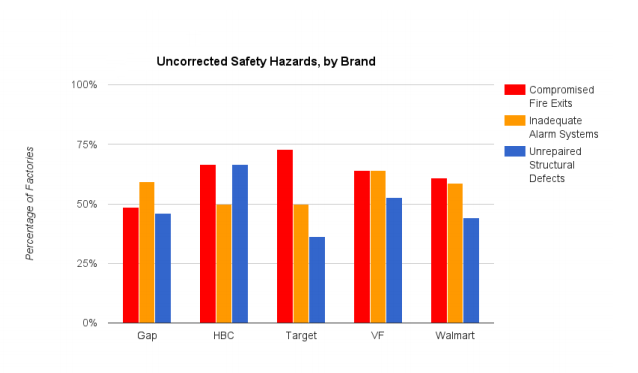
A new report published this week Dangerous Delays on Worker Safety found that of the 107 factories labelled “on track” by The Alliance for Bangladesh Worker Safety, 99 were still falling behind in one or more safety categories. In light of Li Edelkoort’s observation that brands are spreading themselves thin, it comes as little surprise to find that brands in the Alliance, which includes brands such as Walmart, Target, Gap inc, VF Corporation (which owns Lee, Wrangler, The North Face, Vans, Timberland and others and has just published its factory lists) have yet to put in place the life-saving safety changes they pledged following the Rana Plaza disaster, which occurred five months after the Tazreen fire. 62% of factories still lack viable fire exits, 62% do not have a properly functioning fire alarm system and 47% have major, uncorrected structural problems. Deadlines for these safety measures to be implemented were supposed to be 2014/15 but have now been moved to 2018, the end of the 5 year period over which the Alliance extends.
Are brands and factory owners really so concerned with the bottom line that they cannot afford to prioritise the installation of something so basic to worker safety as a fire-proof door and the removal of locks from existing doors?
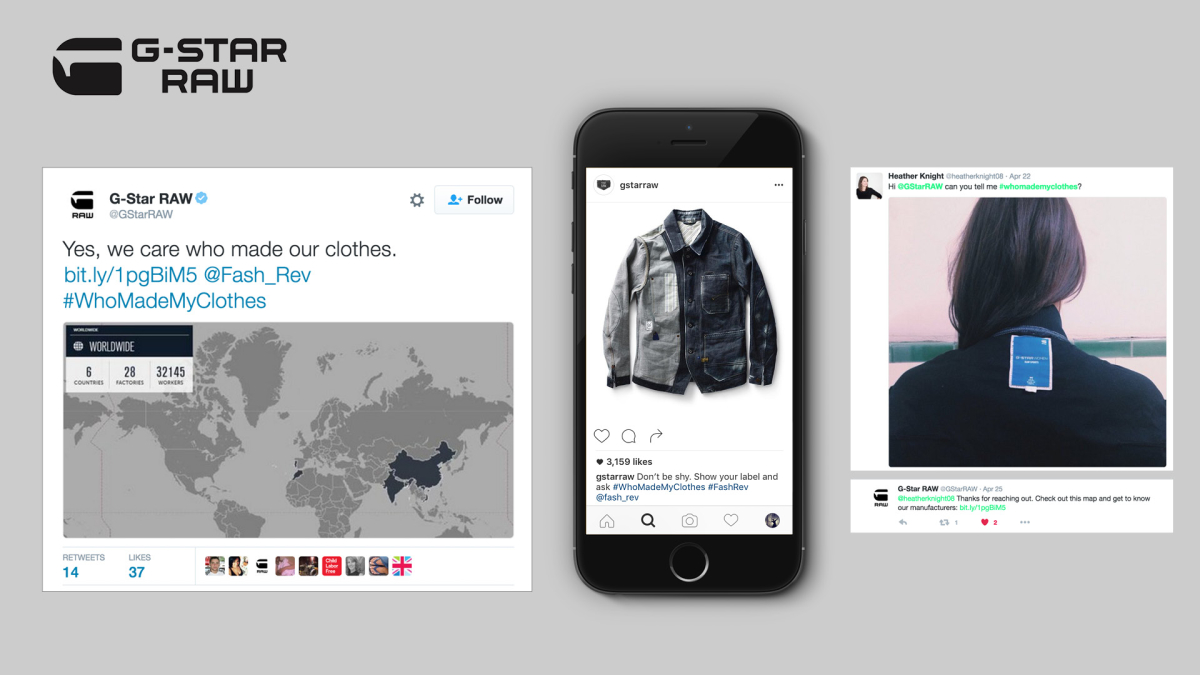
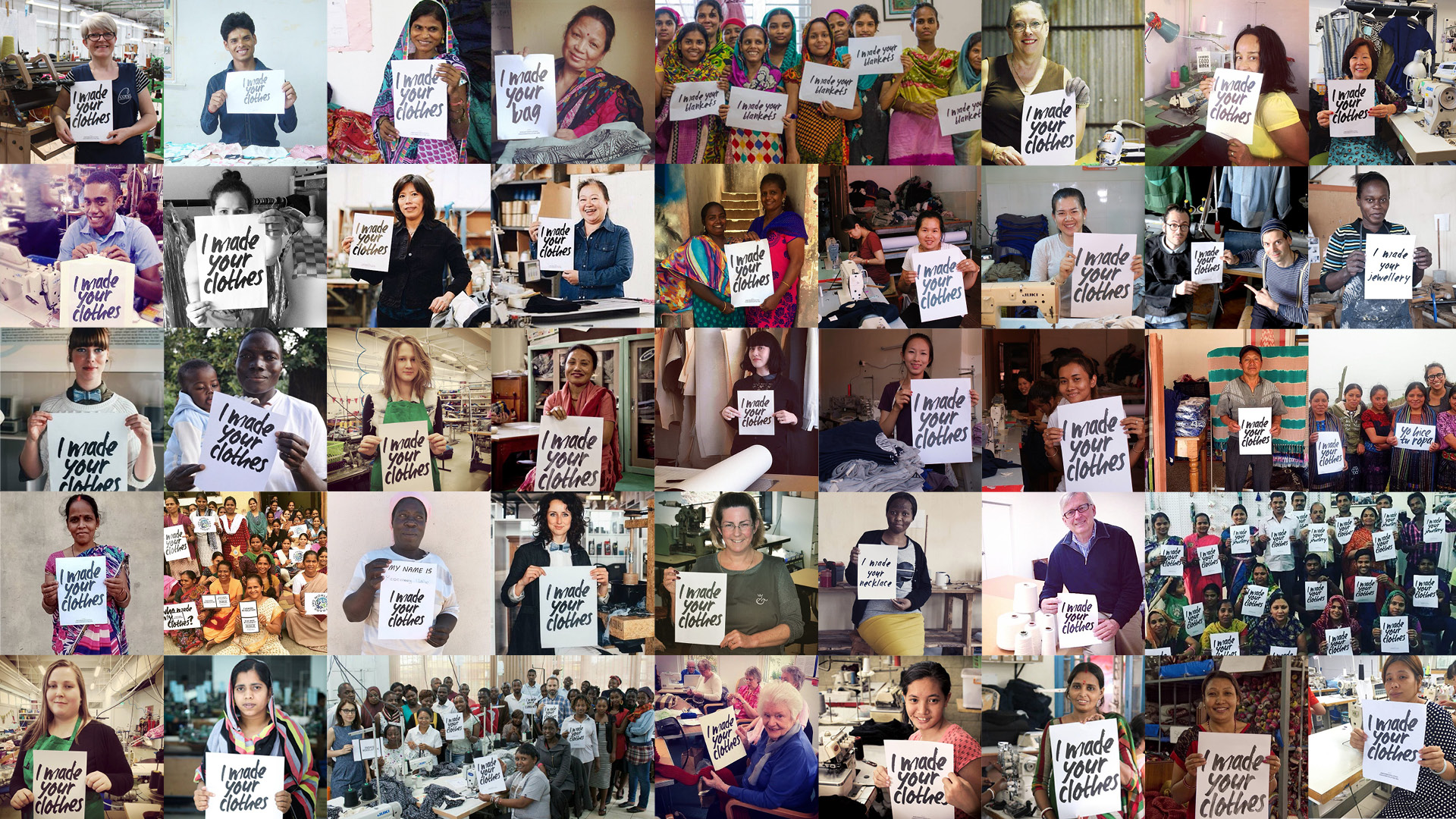
Since the Tazreen fire and Rana Plaza disaster, human rights issues are certainly more visible than ever before and there is ongoing pressure on global fashion brands to become more transparent. Companies are now being held to a higher standard and they are cognisant of this change. During Fashion Revolution Week in April, over 70,000 fashion lovers around the world asked brands #whomademyclothes on social media, with 156 million impressions of the hashtag. G Star Raw, American Apparel, Fat Face, Boden, Massimo Dutti, Zara, Jeanswest and Warehouse were among more than 1250 fashion brands and retailers that responded with photographs of their workers saying #Imadeyourclothes. Read more about our impact here.
However, the harsh reality is that basic healthy and safety measures still do not exist for millions of people who make our clothes and accessories. On 11 November 2016, 13 people died in a factory making leather jackets on the outskirts of Delhi. The front of the building had been shuttered with a metal grill which prevented the workers escaping the blaze. Deadly accidents are still commonplace in fashion supply chains and not enough has been done by brands and retailers to prevent more fashion victims; victims of neglect, oversight and the pursuit of profit.
Scott Nova, executive director of the Worker Rights Consortium says:
“What motivated Walmart and Target to do the right thing is public embarrassment. We are three and a half years on [from Rana Plaza] and they assume memories are fading.”
We have the power and, I believe a duty, to let these brands know that our memories of the Rana Plaza disaster, the Tazreen Fashions fire, and the many other tragedies which have ocurred in the name of fashion, are not fading. By asking the question #whomademyclothes we are applying pressure in the form of a perfectly reasonable question that fashion brands should be able to answer. We are asking them to publicly acknowledge the people who make our clothes; millions of people working in factories, fields, homes and other hidden places around the world. Tragedies like the Tazreen Fashions fire are preventable, but they will continue to happen until every stakeholder in the fashion supply chain is responsible and accountable for their actions and impacts.
As Li Edelkoort said, fashion brands are spreading themselves thin. As their customers, we can help make sure they start to get their priorities right and redress the imbalances of power in the fashion supply chain.
Header photo credit: A young garment worker by Claudio Montesano Casillas
This year, Fashion Revolution Week took place in 89 countries around the world. One of these countries was Turkey.
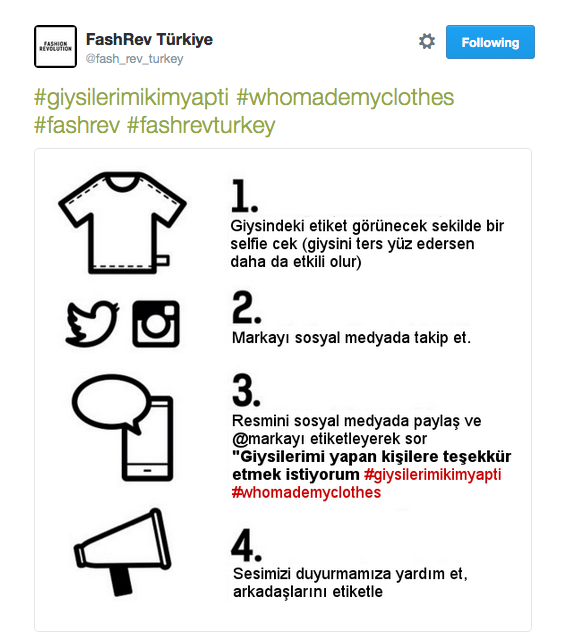
Deniz Ucok saw this post and decided to ask Massimo Dutti who made her T-Shirt #whomademyclothes?
Massimo Dutti is a Spanish clothes manufacturing company, founded in 1985, which is part of the Inditex group. Massimo Dutti is not a real person, but a trademark. Despite the Italian name, it is a Spanish company employing over 4000 people worldwide.
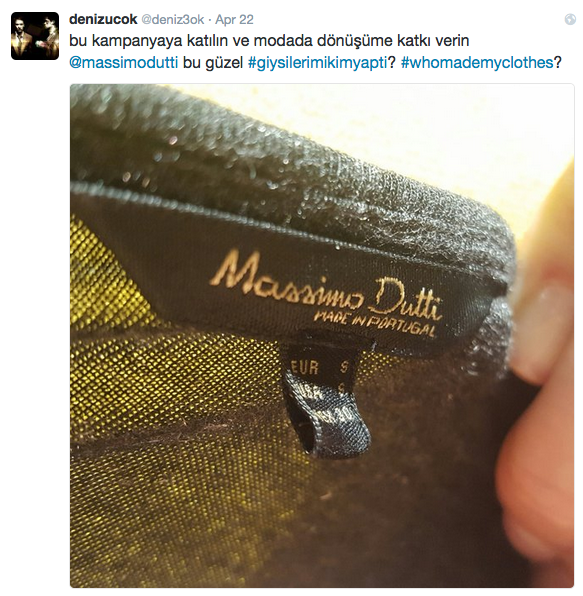
Massimo Dutti responded by asking Deniz to send them a photograph of the labels in her T-Shirt.
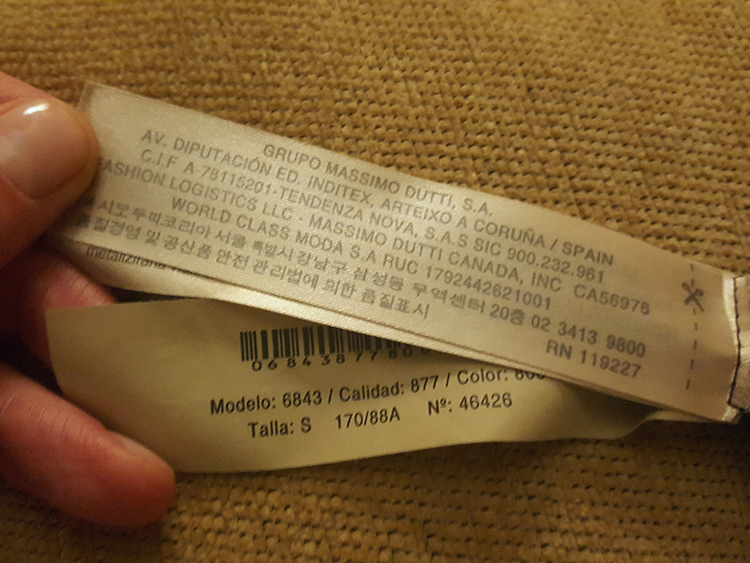
And Massimo Dutti certainly can answer the question #whomademyclothes, as shown by their comprehensive answer below.
Dear customer,
The item you requested information about was purchased from a Portuguese Company for the Summer collection 2016. The name of our supplier is Vieira & Marques, Lda. and their facilities are located at San Martinho Campo. It has 180 employees and it received the highest score during our latest social audit which will be revised again throughout this year (2016.)
During the manufacturing process other Portuguese companies have intervened:
For fabric manufacturing: Vilartex Emp de Malahas V Lda based in Guimaraes and with 106 employees.
For tinting processes: Carvitin Tintura e Acabamentos Lda, based in Coimbra with 56 employees.
For confection: M Look Confeccoes based in Fomelos with 40 employees.
For ironing: Jose Amorim Mota Unipessoal Lda, based in Guimaraes with 67 employees.
All these factories have been examined by our social audits as well as production audits that assure the clothing traceability.
We hope you find this information useful.
Kind regards,
Massimo Dutti
Deniz replied to Massimo Dutti on Twitter.
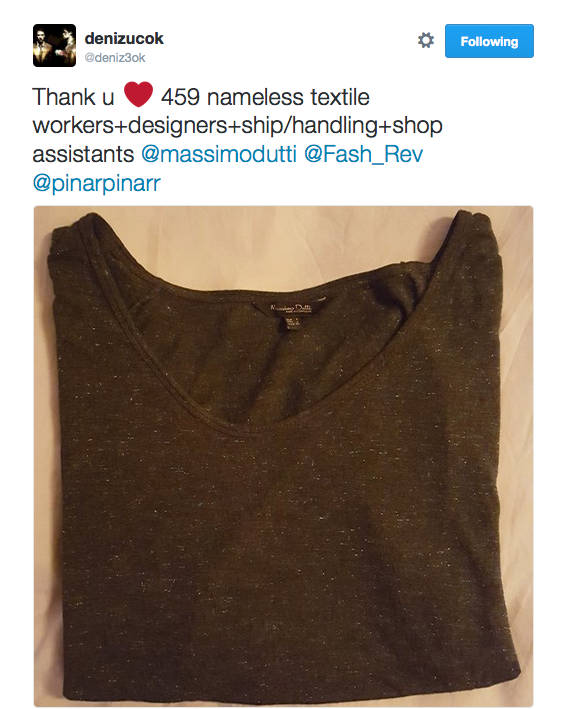
Inditex scored 76% overall in Fashion Revolution’s Fashion Transparency Index, published on 18 April, just one percentage point behind the leader, Levi Strauss & Co. To find out more about the scoring and methodology of the index, please read our Top 10 FAQs
I was working with the Fashion Revolution team yesterday at London College of Fashion. I needed a swimsuit for my upcoming Zoology research trip to the Bahamas and heard that AURIA swimsuits were for sale at the EMG Progressive Fashion Concept Store in Beak Street, Soho, just a few blocks away. I found the perfect swimsuit! As it’s Fashion Revolution Week, I of course had to ask the question #whomademyclothes?
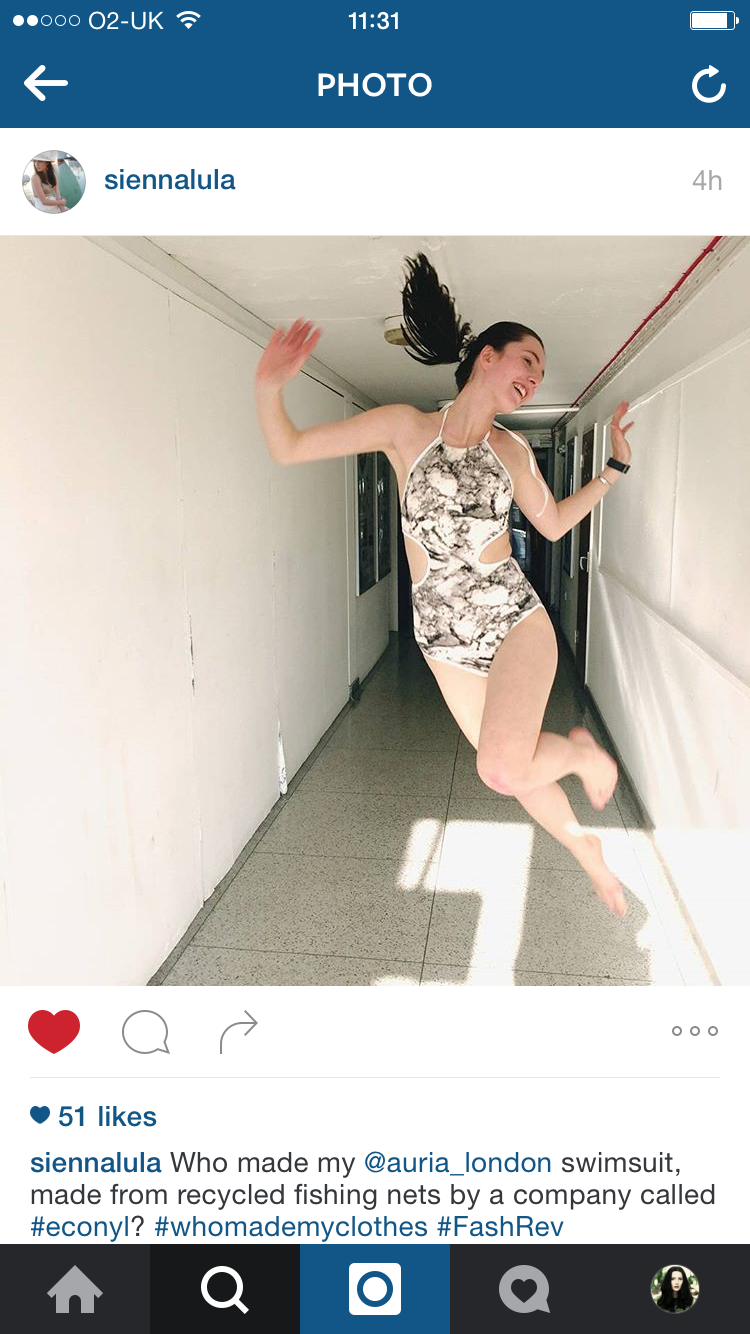
AURIA’s swimsuits are made from Econyl.
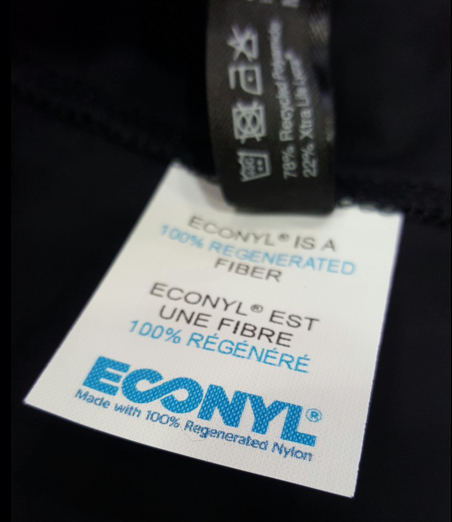
According to their website ‘the innovative ECONYL® Regeneration System is based on sustainable chemistry. With this process, the nylon contained in waste, such as carpets, clothing and fishing nets, is transformed back into raw material without any loss of quality.
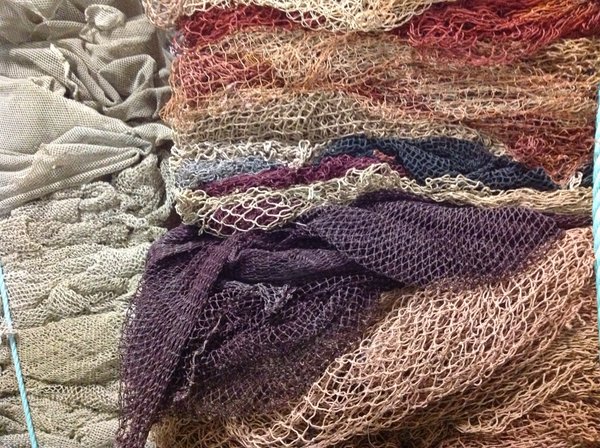
And here are the people who made my swimsuit …
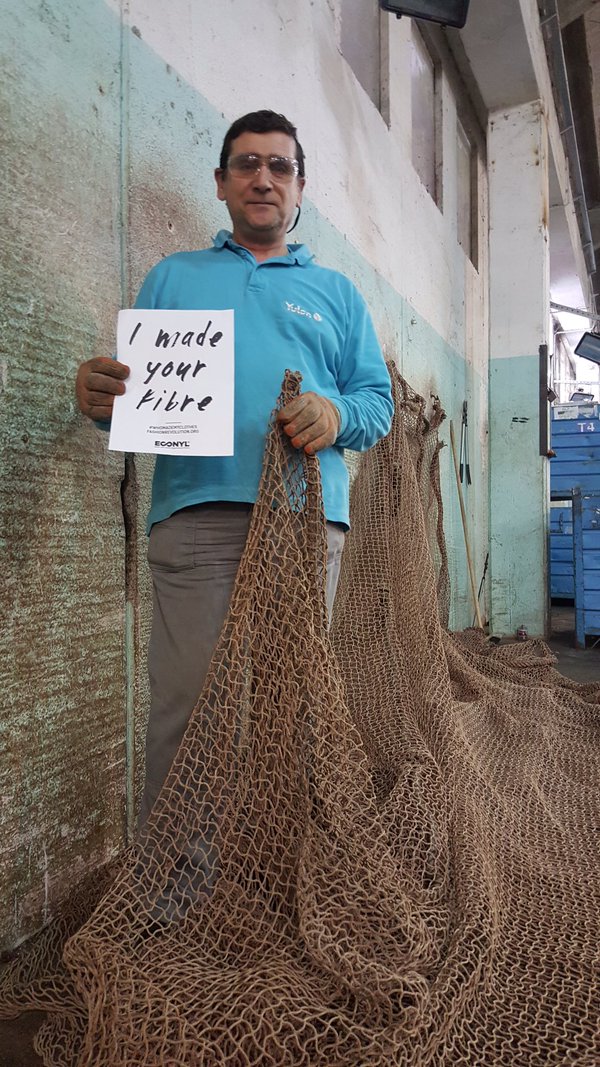
This is Paolo in the ECONYL plant He prepares nets for regeneration
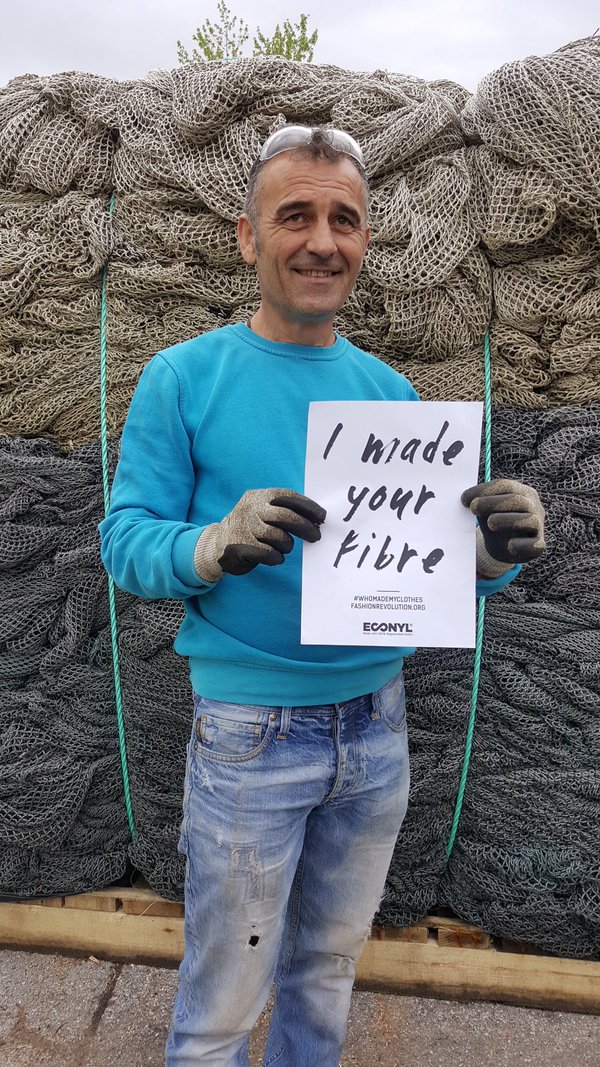
This is Ivo with some nets to be turned into ECONYL yarn
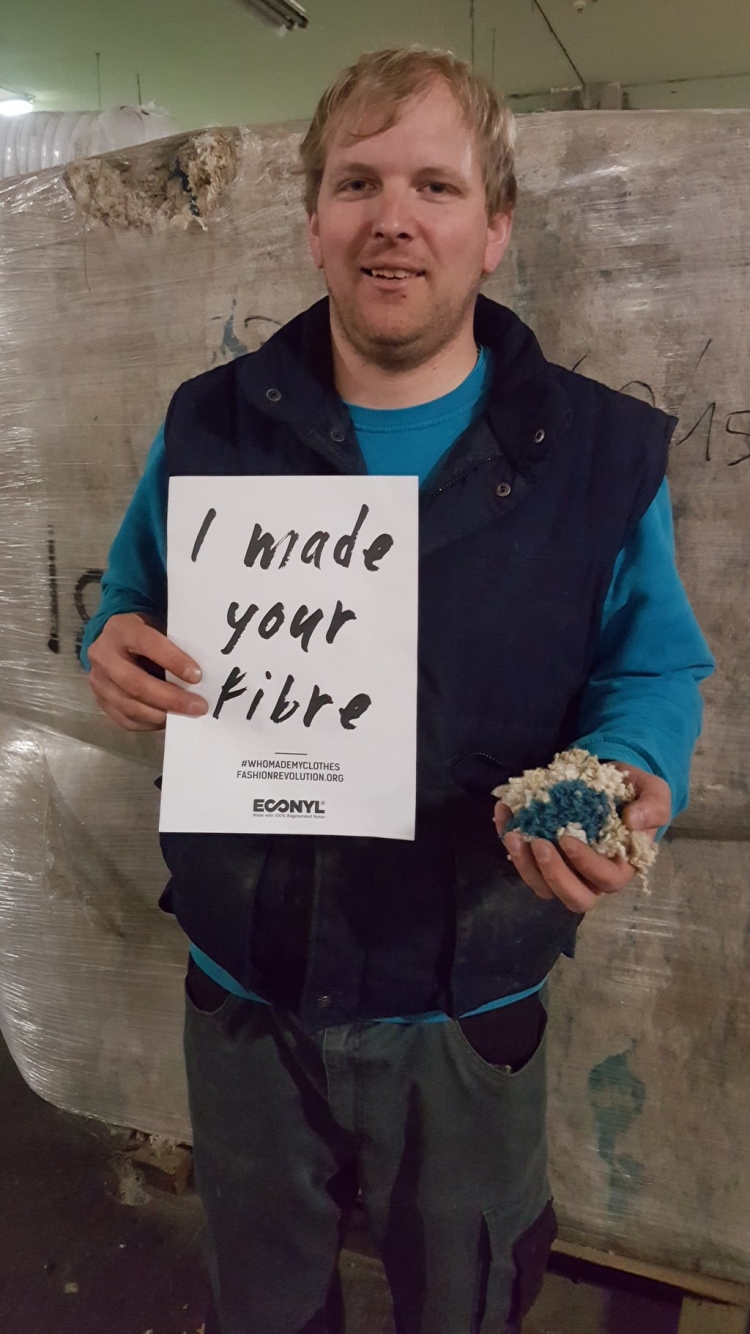
Jan with some carpet fluff, the upper part of old carpets that is regenerated into ECONYL yarn
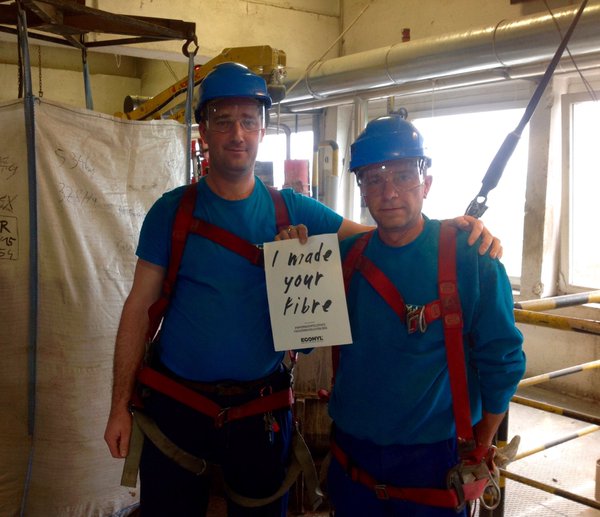
Denis & Mladen they are at the very beginning of the ECONYL regeneration process
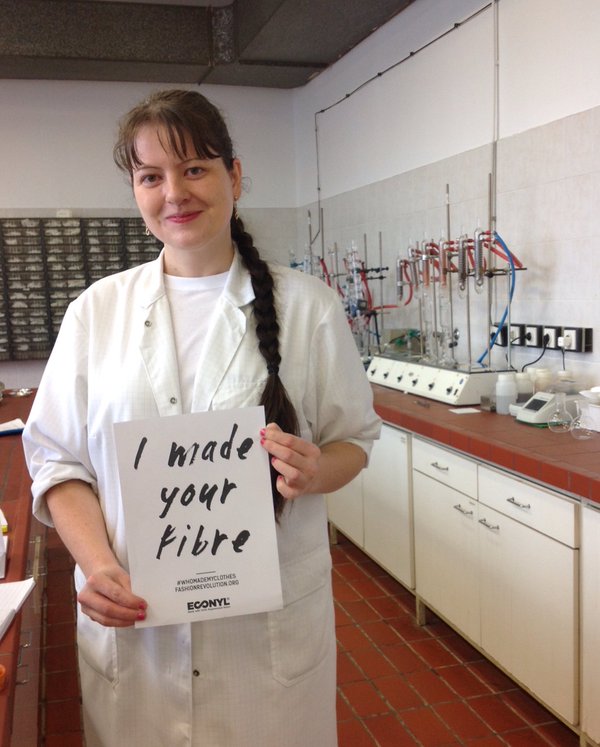
Jozica works in the chemical lab. She checks the waste material that will become ECONYL yarn
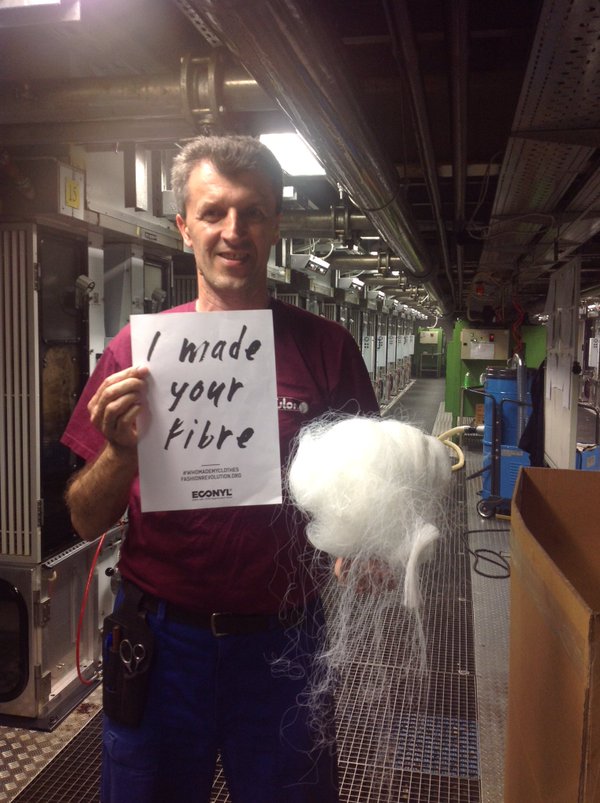
Mirko keeps an eye on the spinning to get the best quality ECONYL regenerated yarn in Slovenia
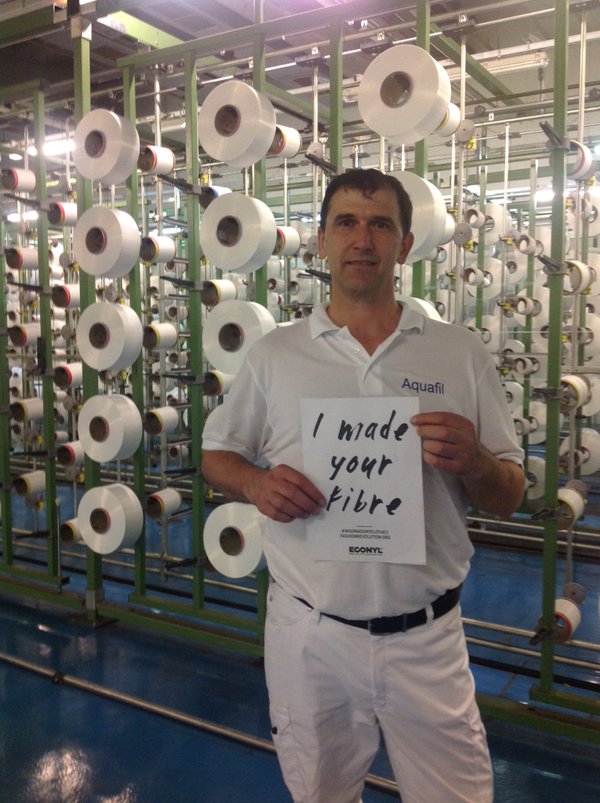
You can always find Boro around the bobbins of ECONYL regenerated yarn to check quality
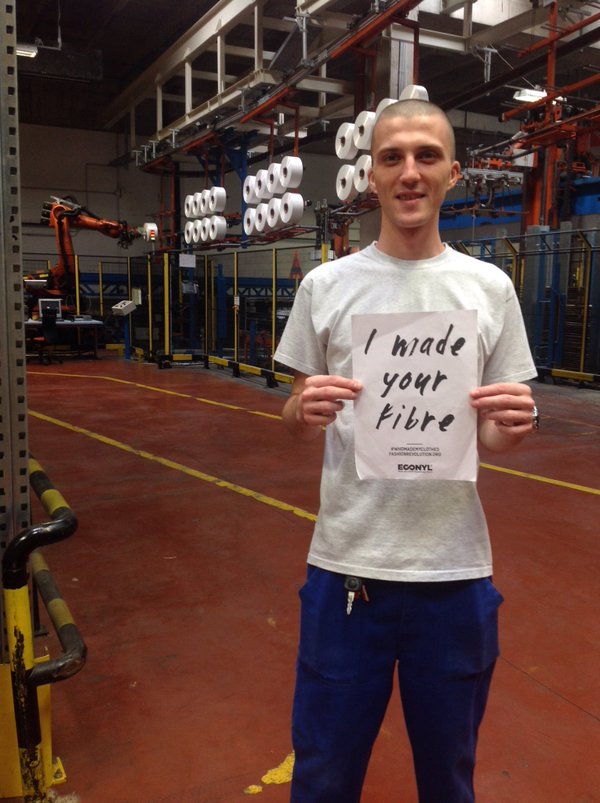
Bobbins of ECONYL regenerated yarn wouldn’t get to clients if it wasn’t for Muamer
And all of this recycled fibre then gets made into gorgeous AURIA swimsuits
I’m really happy to see that ECONYL is able to answer the question #whomademyclothes and show me the faces of everyone who has helped to make the fibre for my new swimsuit #imadeyourclothes.
#whomademyclothes……..do you ever wonder? We are super excited that Fashion Revolution has opened the doors for people to explore this question and find answers. We are happy to share our story about the manufacturing of our Gypsy and Lolo accessories.
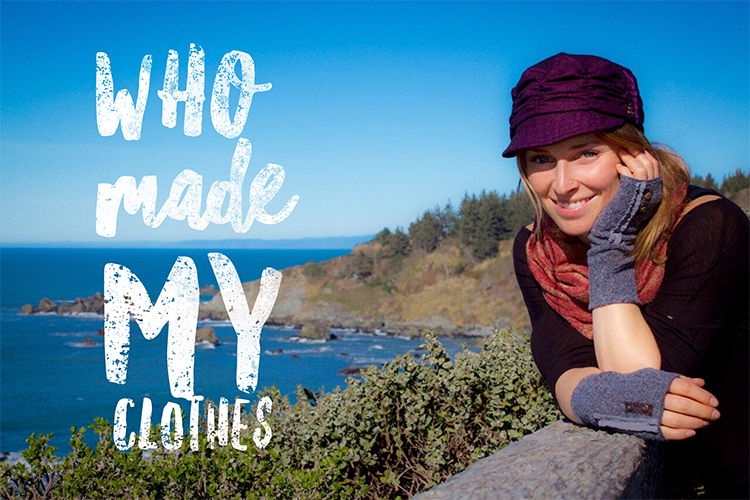
It all starts in North Carolina where our fabric is made from recycled cotton yarns. Here are Rodger and Jonathan working on one of the knitting machines.
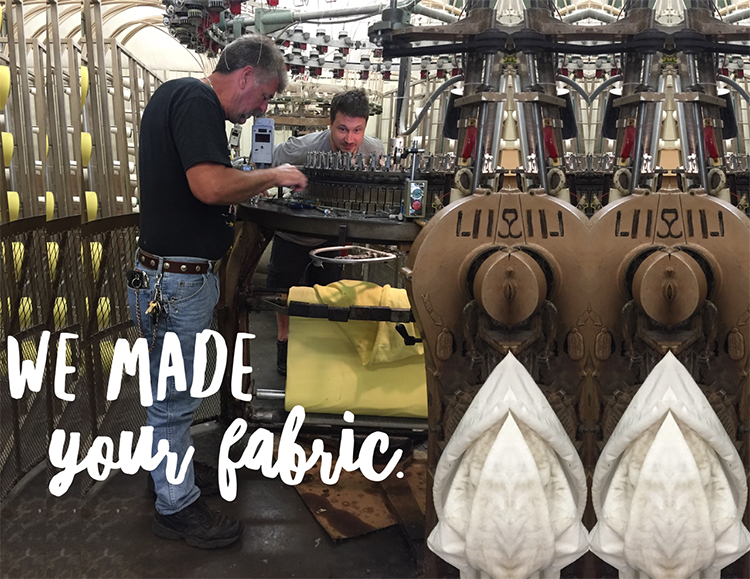
Once the fabric is made it is shipped to our cutting factory in Oakland CA where it is cut by Daniel. Below is a photo of Daniel and his assistant rolling out fabric on the cutting table.
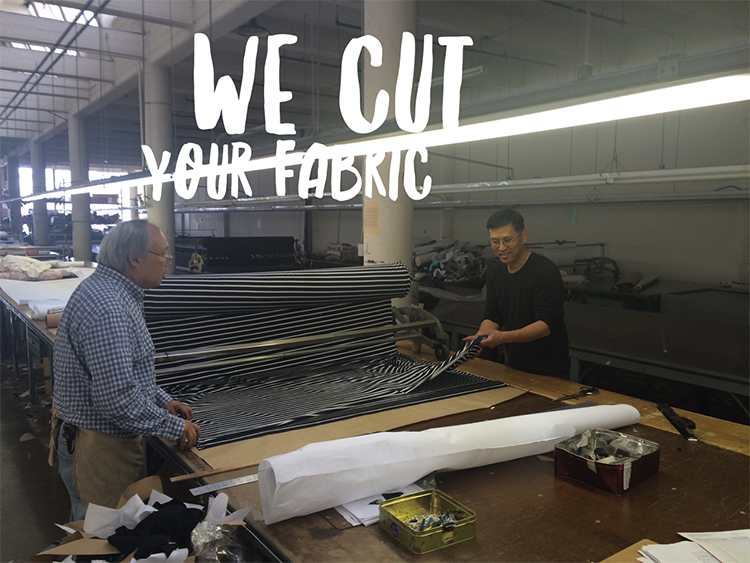
All the cuts travel from Daniels to our sewing factory in Alameda, Ca.
That’s about a 3 mile trip!
Angela and her sister Connie have owned and operated their small sewing shop in Alameda for 27 years. They employ 12 people all of which are paid and treated fairly. Both Angela and her sister Connie work alongside their employees, ensuring that they all have a good environment to work in. We often visit their factory with our 2 children and all of the workers greet them with smiles and treats.
Here is Angela working on a pair of our wrist warmers.
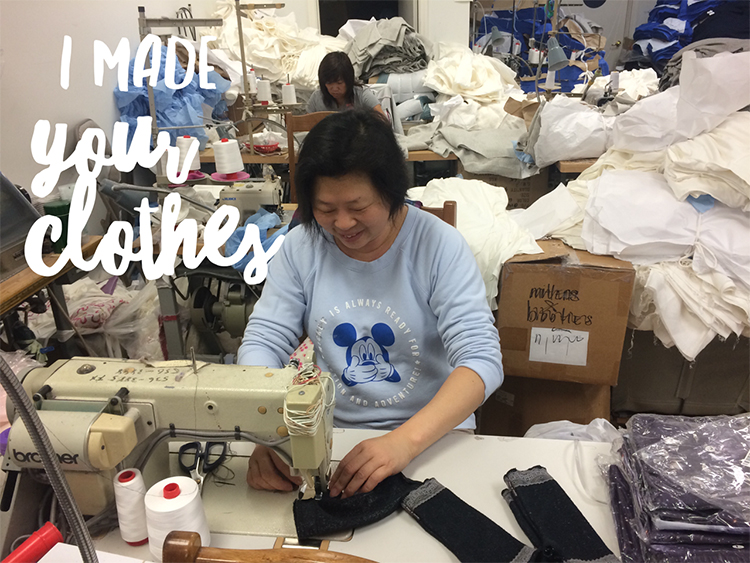
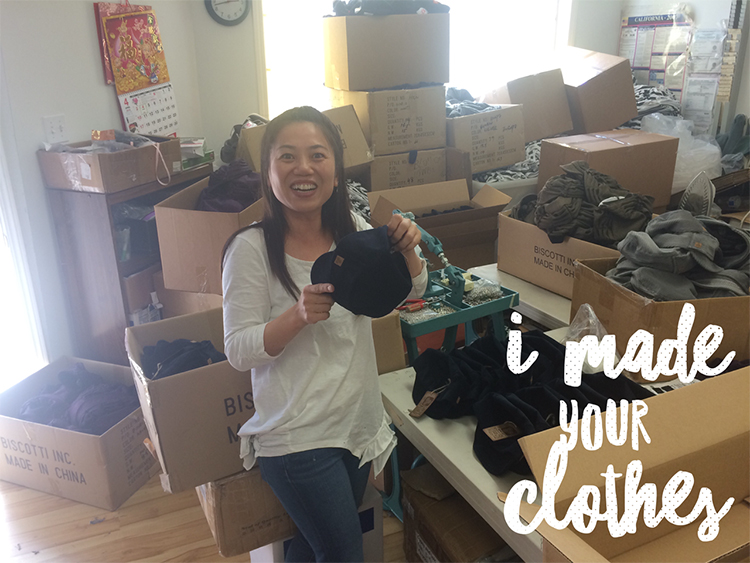
This is Chang sewing our scarves.
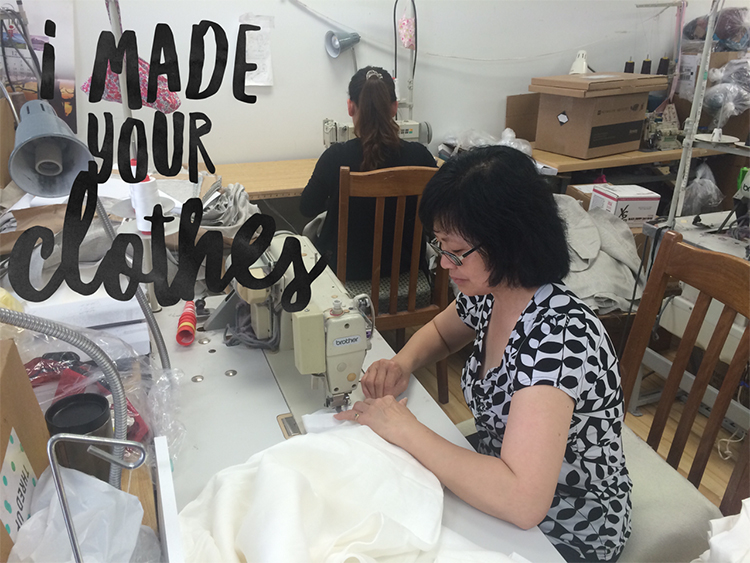
Karen doing the last inspections on our hats and getting them ready to ship to our warehouse in Arcata, Ca.
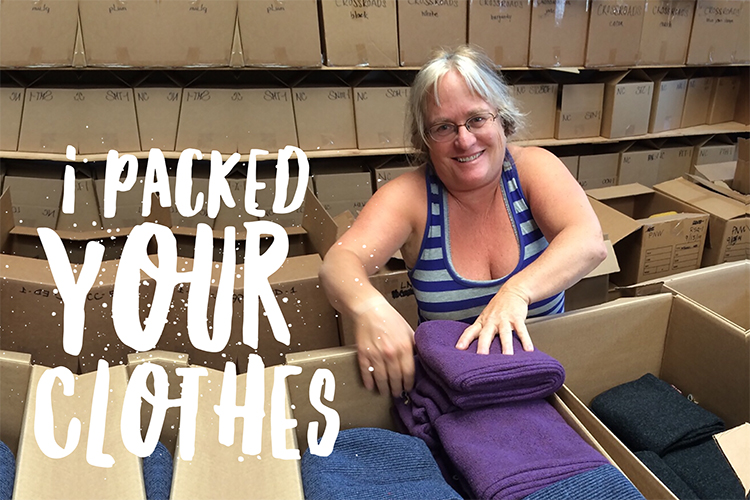
Now that all of our accessories are done being sewn they are ready to be packed and shipped off to stores across the USA. We do all the shipping from our warehouse in Northern CA. Here is Gypsy’s mom Nancy packing the boxes.
Thanks for caring and supporting brands that are ethical, eco friendly and transparent with their manufacturing process.
Sincerely, Loic (Lolo) and Gypsy

This website was created and maintained with the financial support of the European Union. Its contents are the sole responsibility of Fashion Revolution and do not necessarily reflect the views of the European Union.