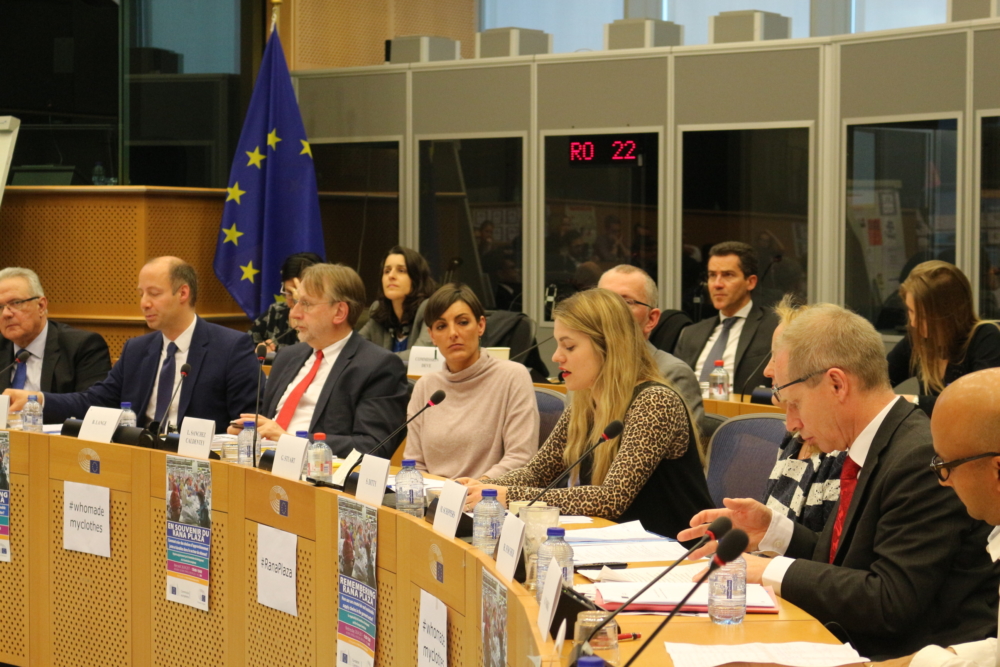
On 26th April 2017, Fashion Revolution’s Head of Policy, Sarah Ditty, spoke at a high-level meeting in the European Parliament “Remembering Rana Plaza – how can we create fair and sustainable supply chains in the garment sector?”
This event came the day before an important plenary vote by Members of the European Parliament (MEPs) on a report pushing rules to curb worker exploitation throughout fashion’s global supply chains.
Good news! The European Parliament passed the resolution 505 votes against 49 with 57 abstentions. The hope is that this will lead to laws, which will ensure better working conditions for the people who make our clothes. Read the speech that Sarah gave yesterday to the European policymakers in support of the report and #whomademyclothes
“Fashion Revolution was born out of the Rana Plaza factory collapse. It started with a group of a dozen designers, academics, writers, fashion professionals and concerned citizens who felt enough is enough. A big push for system-wide change was needed more than ever.
We have since grown to become the largest fashion activism movement in the world with teams in 100 countries, including most European countries. Fashion Revolution Week is a time when hundreds of thousands of people all around the world take to social media and the streets to ask one simple question: who made my clothes? We believe this simple question gets people thinking differently about what they wear. We believe this simple question has the power to push the industry to be more transparent. If brands and retailers are encouraged to answer this question, they must take a closer look at their supply chains.
Last April our campaign reached 159 million people globally through social media and our online media reach alone in April was over 22 billion across more than a thousand articles in the press and blogs.
During this week, we also encourage producers and workers to respond with the hashtag #imadeyourclothes allowing them to stand up, be seen and celebrated, and we ask brands and retailers to respond to #whomademyclothes in order to demonstrate transparency in their supply chain. We are seeing brands increasingly getting involved.
I am here today representing the hundreds of thousands of people who participate in Fashion Revolution’s call for a safer, cleaner, fairer and more transparent apparel industry — particularly young people — of which tens of thousands of us are residents and citizens of European countries, your constituents, to tell you how much we love fashion but that we don’t want our clothes to be made off the back of exploitation, poor working conditions, unjust trade and environmental destruction. That’s a price we truly do not want to pay or worse, to inflict on others. And we believe that the government’s role — at the European level — is crucial to ensure our clothes are never made in this way.
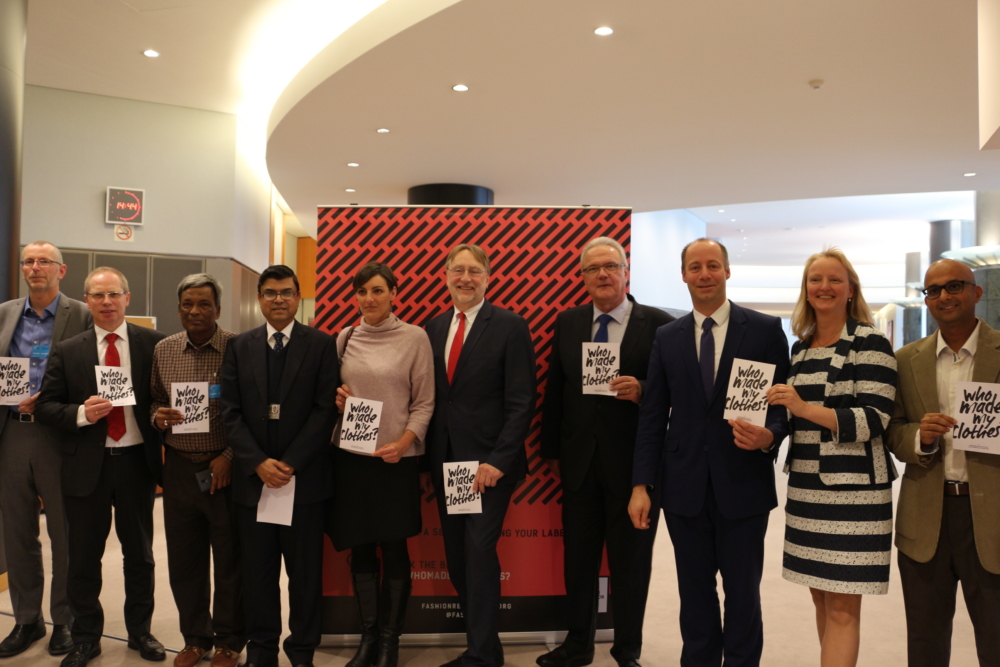
Through our movement we celebrate fashion as a positive influence while also questioning, at times scrutinising, the industry’s practices and raising awareness of its most pressing issues.
We aim to show that change is possible and encourage those who are on a journey to create a more ethical and sustainable future for fashion. But responsible purchasing decisions are not easy to make. As consumers, we just don’t know enough about the impacts of our clothing. This needs to change.
On Monday we launched the second edition of the Fashion Transparency Index. We have reviewed and ranked 100 of the biggest global fashion brands and retailers across a variety of market segments including high street to sportswear to luxury. Brands have been ranked according to how much information they disclose about their suppliers, supply chain policies and practices, and social and environmental impact.
Brands achieved on average 49 out of 250, which is less than 20% of the total possible points. And none of the brands on the list scored above 50% — proving that there is still a long way to go towards transparency.
Overall brands are publishing the most about their policies and commitments — with 98% of the brands publishing at least some relevant social and environmental policies. However, far more space is given to brands’ values and beliefs than to their actual actions and outcomes. Brands score far fewer points when you drive further into detail about the impact of their practices on the lives of workers in their supply chains and on the environment.
The good news is that 32 of the brands are publishing supplier lists, at least at the first tier — where they have direct sourcing relationships and where garments are typically cut, sewn and trimmed. This is an increase from last year when we surveyed 40 big fashion companies and only 5 were publishing supplier lists.
In the past year we have seen brands such as ASOS, Gap, Marks & Spencer, and several others publish factory lists. This is a welcome and necessary step forward. 14 out of the 100 brands are also publishing their processing facilities where clothes are dyed, printed, laundered and otherwise finished at an earlier stage of production.
However, no brand publishes its raw material suppliers so there is no way of knowing where our cotton, wool or other fibres come from, who produces them and under what conditions. Meanwhile only 34 of the 100 brands we reviewed have made public commitments to paying living wages to workers in their supply chains, and only four brands are reporting progress against this goal — progress that has been very slow.
Finally, I would like to stress just how difficult it is to find information about brands’ supply chain and sustainability efforts. Information is often found many clicks away from the homepage of brands’ websites; or you might have to trawl through a 300+ page annual report; or you might find information using all sorts of different industry jargon and presented with an array of different visuals. No wonder consumers find it all so confusing! How are we supposed to make informed decisions about what we buy when the information is either entirely absent or presented in such varied and complicated ways?
We hope the findings of the Fashion Transparency Index encourages more consumers to ask brands #whomademyclothes pushing for more disclosure about the products we buy and wear. We hope the Index influences brands and retailers to start disclosing more information about their suppliers, practices and impacts too. We believe it will.
We hope our research facilitates the good work already being done by NGOs and unions on the ground in producing countries, equipping them with clearer data. And finally and most importantly for today’s vote, we hope that our work demonstrates to you policymakers the pressing need not only for greater transparency from the industry but that this must be underpinned by mandatory due diligence and regulations that have real teeth so that there will be a “race to the top”— and so that the brands who are trying to do the right thing no longer face a market where brands are competing on the basis of the cheapest labour costs or the cheapest materials and processes but rather on the basis of quality, design and creativity.
We, Fashion Revolution, as a voice of thousands and thousands of everyday concerned European citizens and consumers, ask you to vote in favour of the report tomorrow. We hope this is the first step towards a fashion industry in Europe that values people, planet and profit equally.”
Friday marked the two year anniversary of the devastating collapse of Rana Plaza garment factory in Bangladesh. It also marks the second Fashion Revolution Day, launched last year to commemorate the Rana Plaza disaster with the aims of encouraging greater collaboration across the fashion sector supply chain.
The Rana Plaza disaster has been said to be a “wake up call”, an “eye opener”, a “game changer” and the “end of business as usual” in the global garment supply chain. It has indeed changed the garment industry landscape in Bangladesh and led to many improvements in the fashion supply chain. Western clothing companies, trade unions and the Bangladeshi government have taken steps to improve workplace safety. The legally binding Accord on Fire and Building Safety, run by European brands and retailers, and the Alliance for Bangladesh Worker Safety, led by North American retailers, were formed to ensure safer working conditions at the bottom of the supply chain. A series of inspections in Bangladeshi factories are being conducted, contributing towards better working conditions in Bangladesh and hopefully across fashion supply chains worldwide.
While these developments are encouraging, more needs to be done to accelerate efforts to tackle safety hazards in the factories of low-cost manufacturing countries.
Sedex data shows that more than half (52%) of all issues raised in ethical audits on the Sedex system globally over the past two years are related to health and safety. The highest risks in the garment sector in Bangladesh are related to fire safety: 25% of audits on the Sedex system show problems with fire safety in Bangladesh. Fire safety concerns are also at the top of risks in other garment-producing countries – Pakistan (19%), China (18%) and India (17%) – endangering the lives of workers and posing a big risk to brands, suppliers and investors. Other major risks include building safety, labour rights, working hours, machinery and lack of personal protective equipment & clothing.
The Bangladesh Accord looks predominately at fire and building safety in Bangladesh, but fashion supply chains are affected by many other issues. Garment workers in Bangladesh face poor working conditions and issues around freedom of association, according to the latest report by Human Rights Watch. Countries need to effectively enforce labour laws and ensure that garment workers are able to voice their concerns about safety and working conditions, without fear of being fired, intimidated or assaulted. There is also need to investigate unfair labour practices and ensure workers are paid a living wage.
The garment, textiles, clothing and footwear industry is among the most labour intensive industries, estimated to employ more than 60 million people worldwide. In Bangladesh alone there are more than four million garment workers. But the costs for garment production in Asia are rising, and the garment industry is increasingly moving to other regions, for example Africa. As these new markets are preparing for an influx of new business – building new factories to employ a huge amount of local people – it is crucial to ensure that safety requirements are built in from the very beginning.
The global fashion industry has the power to change its supply chain and positively impact working conditions. Collaboration is key here, amongst Sedex global community we see real progress when buyers and suppliers collaborate between all levels of the supply chain. Leading companies are looking beyond the usual boundaries of responsible sourcing to consider the wider context around responsible sourcing challenges. For example, Marks & Spencer is going outside its factories into communities, working towards empowering women and improving livelihoods of workers.
Change is happening, slowly but steadily. Collaboration among companies, government and, NGOs is essential in delivering improvements in working conditions and ensuring workers well-being throughout global supply chains.

This website was created and maintained with the financial support of the European Union. Its contents are the sole responsibility of Fashion Revolution and do not necessarily reflect the views of the European Union.