The sea. It is a sea upon which wars have been fought, across which goods and slaves have been traded, across which we have journeyed for centuries to exploit ‘new’ lands, decimate indigenous populations with our diseases and return with their treasures, and across which we are sailing today to investigate ocean plastic pollution.
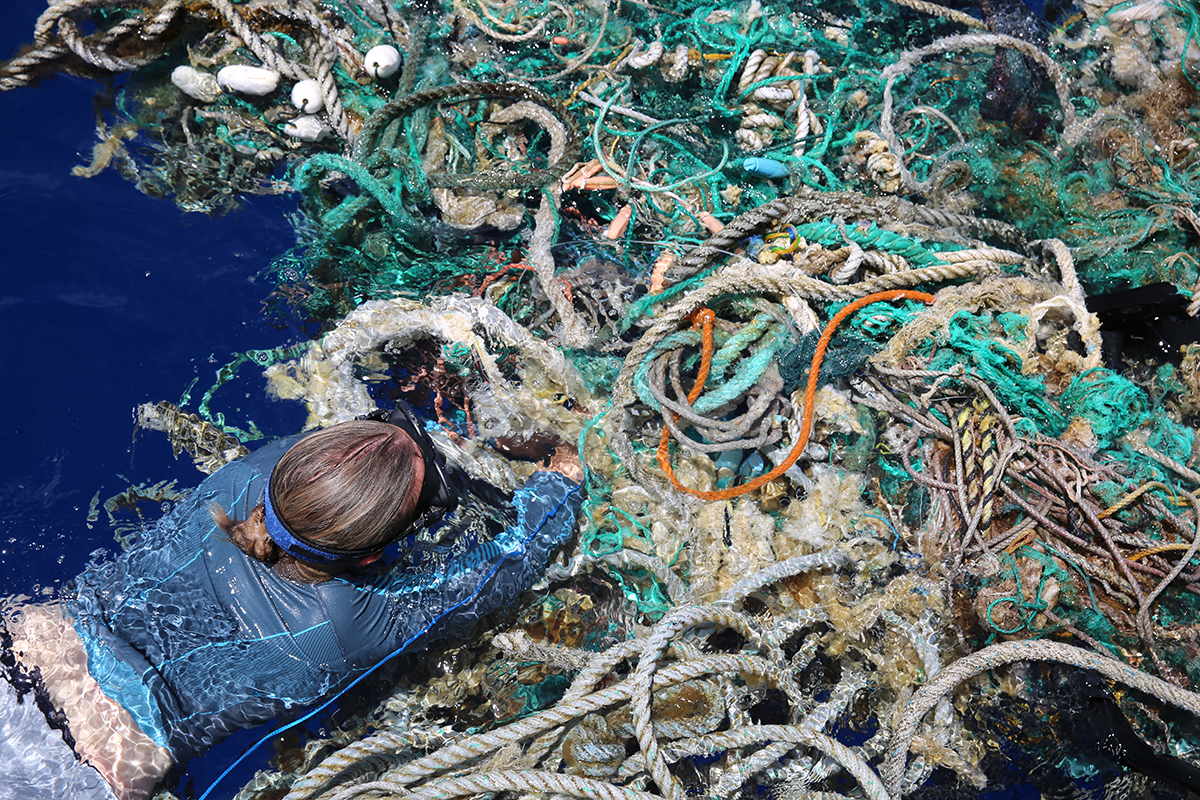
The sea. Writers and poets speak of the silver sea, the lonely sea, the audacious sea, the sublime sea…. The plastic sea doesn’t have quite the same ring to it, yet that is one of the predominant qualities of the sea in this area of the South Pacific, and the reason why we are making this voyage south from Galápagos to Rapa Nui, Easter Island. We will be sailing into the South Pacific Gyre where the world’s predilection for plastic is at its most visible.
As we sail with two thousand miles of blue before us, we will experience many faces of this mercurial sea.
On our first day at sea, an hour out of harbour, we passed the meeting of currents which had split as they passed around San Cristóbal and were rejoining on the other side of the island, tracing an almost glass-like, curvilinear track between deeply furrowed verges.
CURRENT, in navigation, courans, (currens, Lat.) a certain progressive movement of the water of the sea, by which all bodies floating therein are compelled to alter their course, or velocity, or both, and submit to the laws imposed on them by the current. An Universal Dictionary of the Marine 1769. And therein lies our challenge on this voyage. How to bring velocity to a cultural current to move behaviour and habits faster around plastic pollution?
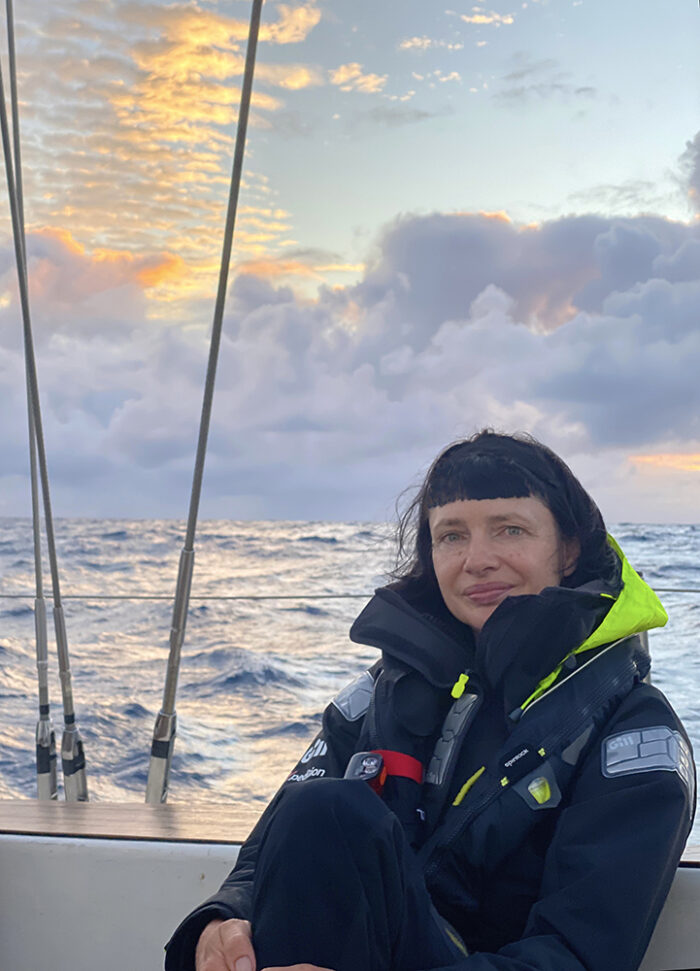
On the first night, the sea slooshed companionably against the hull and its undulating voice lulled us into the gentlest of womb-like sleeps until we are woken four hours later for our next watch. The midnight watch is my favourite. I walked up the companionway steps into a dark starscape. (No-one on board knows why a ship’s corridor is called a companionway as, on SV TravelEdge at least, it is barely wide enough for two people to pass) The moon sat like a luminous saffron saucer on the table of the horizon.
On the second night, the sea whispered conspiratorially and lured us with the glittering phosphorescence of a billion plankton. A shoal of flying fish were visible as white flashes of leaping light to starboard and the brightest of shooting stars illuminated the night sky.
On the third day we tangoed across the waves and eddies, our white ruffled line tracing a course across the deep blue dancefloor. Sea sickness set in amongst many of the crew as the sea roiled and seethed with a short swell and science was postponed in the hopes of a return to a kinder ocean tomorrow.
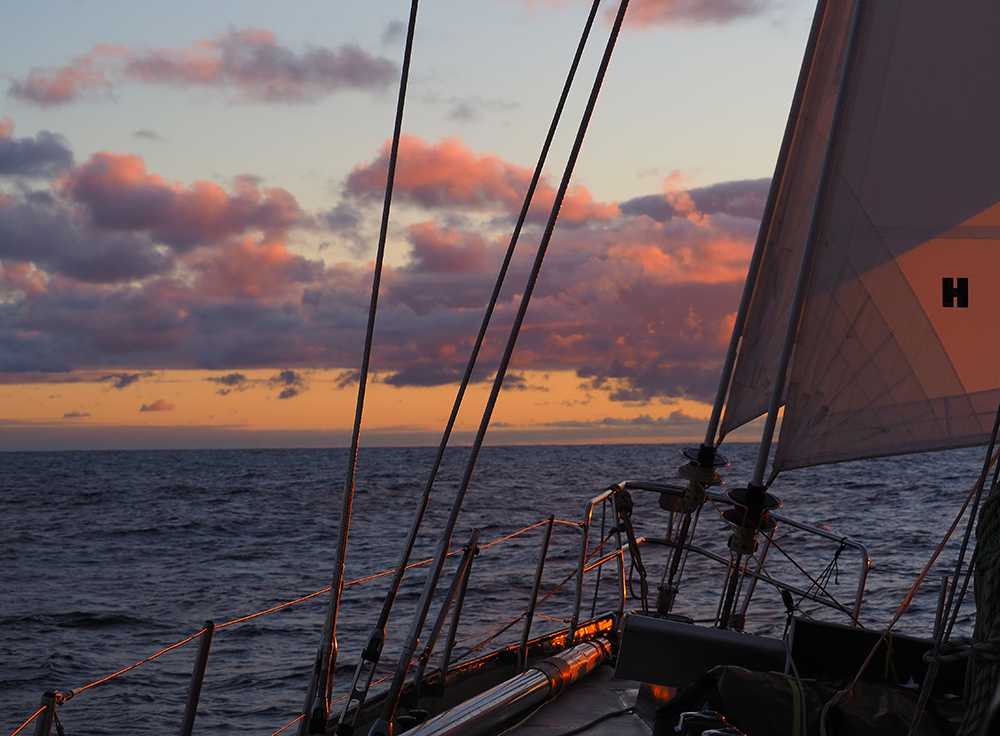
WAVE, a volume of water elevated by the action of the wind upon its surface, into a state of fluctuation. Definition from An Universal Dictionary of the Marine, 1769. We start asking ourselves, what are the actions we can take as a multidisciplinary crew to build momentum, to agitate, to sweep away resistance and create an unstoppable wave of change?
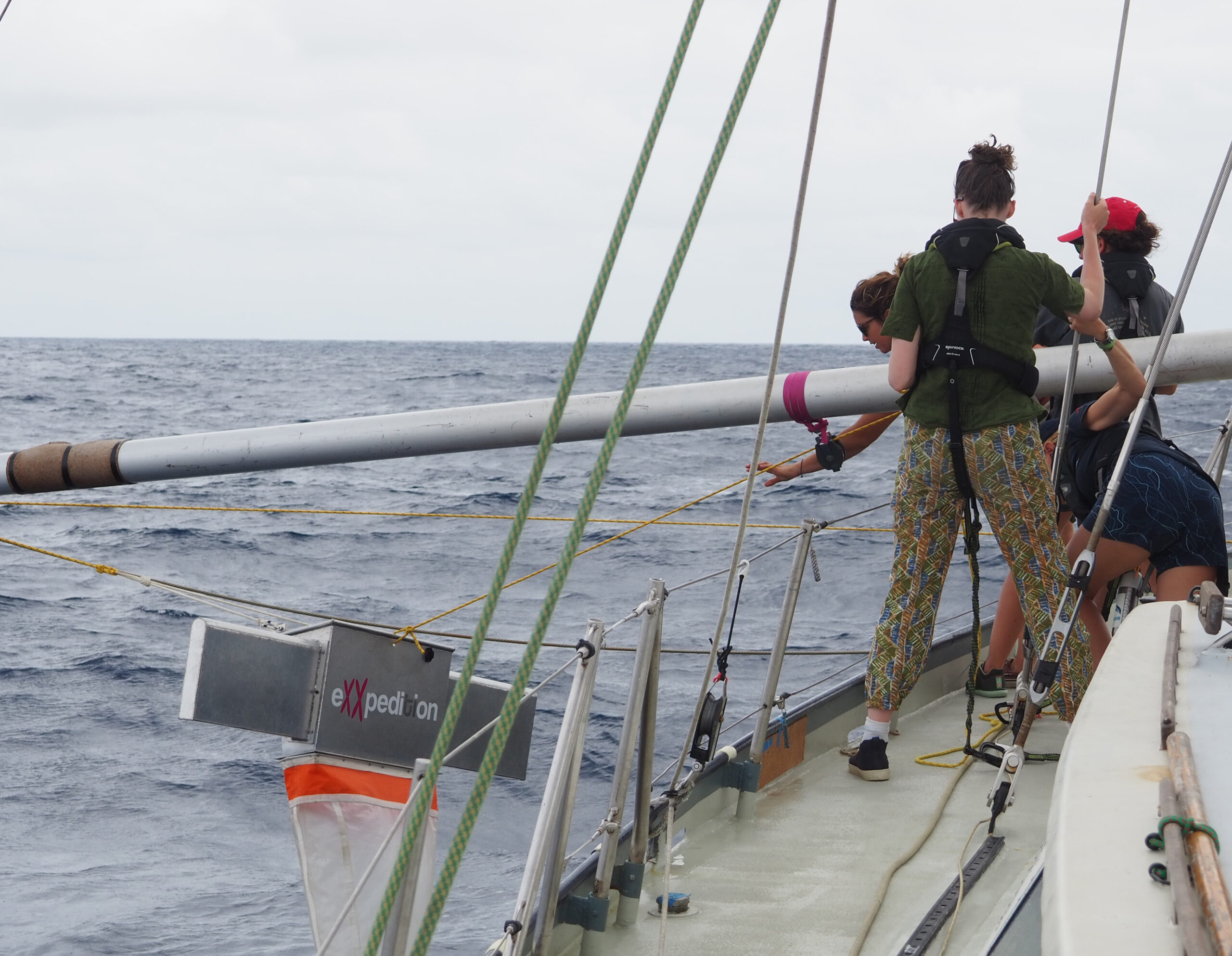
On the fourth day the swell lengthened, so we twice dropped the Manta Trawl off the spinnaker pole for half an hour each time. The contents of the trawl were passed through three sieves of increasingly fine mesh. Several Men o’ War but no visible plastic.
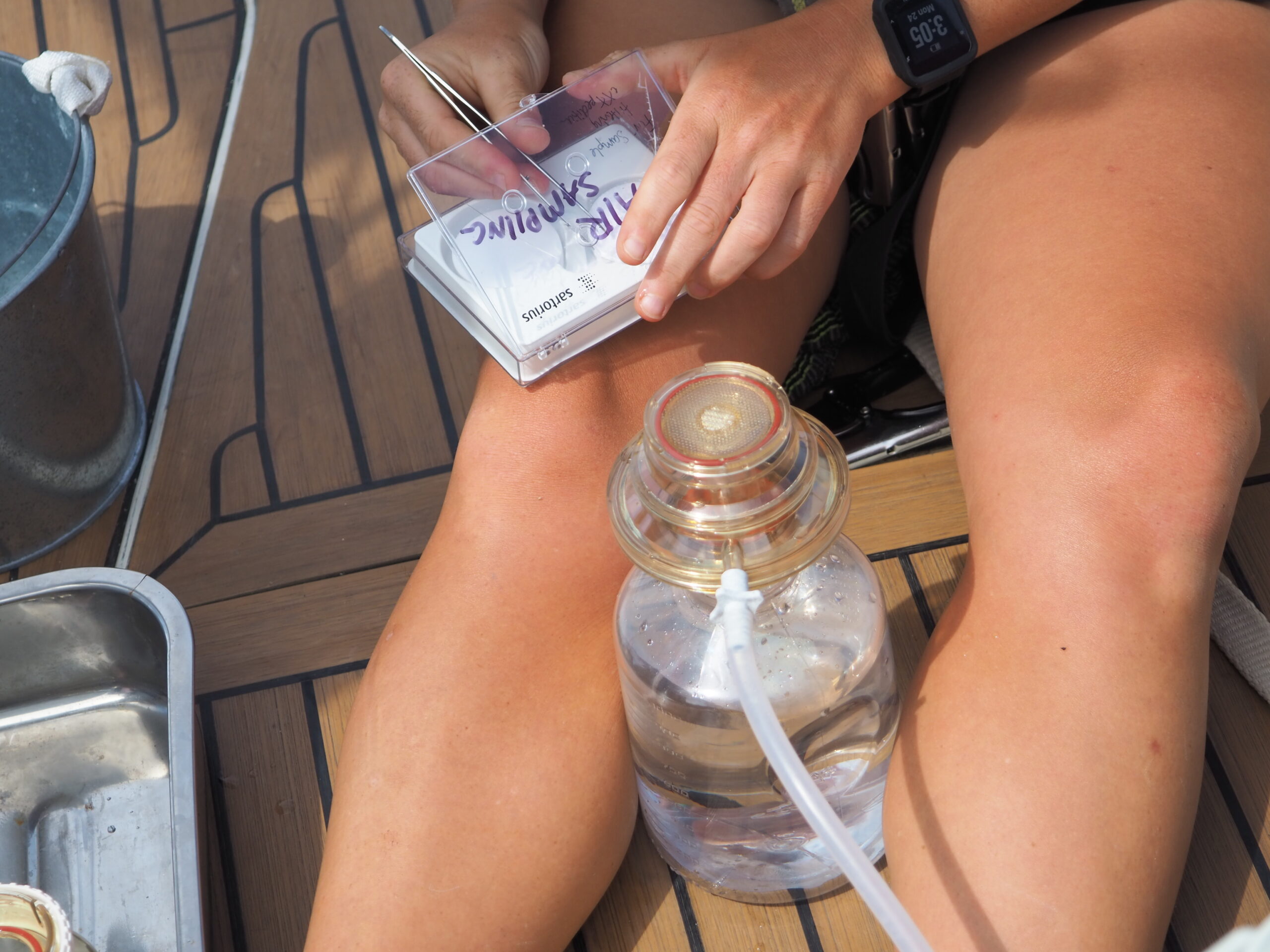
On the fifth day we made our first drop of the Niskin Bottle. I watched it plunge down into the unfathomable depths of the ocean, astonished by the clarity of the water as the rope extended to its full 25 feet. We whispered ‘Find the Niskin’ as we deployed the messenger weight, known on board as the golden snitch, which triggers the Niskin to close. These samples will be sent back to the lab in Plymouth to analyse how the types and quantities of microplastics in the subsurface compare to the surface water and will be the first global dataset of its kind.
On the sixth day Maggie, our first mate, hoisted metal buckets up the Mizzen mast. These will be left there for 311 nautical miles to determine whether microplastics are being transported by winds.
As the voyage continues, the wind drove us on towards our destination, with scurrying clouds and a seething sea painted a hundred hues of blue, green, grey and white. We pitch and roll. Sleep is difficult as the sheets and rigging rattle overhead and we slide into the leecloth or hull, depending on whether our bunk is port or starboard. We pass the 1000 mile mark – halfway through our voyage. Our night watch is spent creating a humorous poem about our voyage and crew based on the Beaufort Scale, which rates wind force from 0 to 12, although we have only experienced up to Force 6 to date.
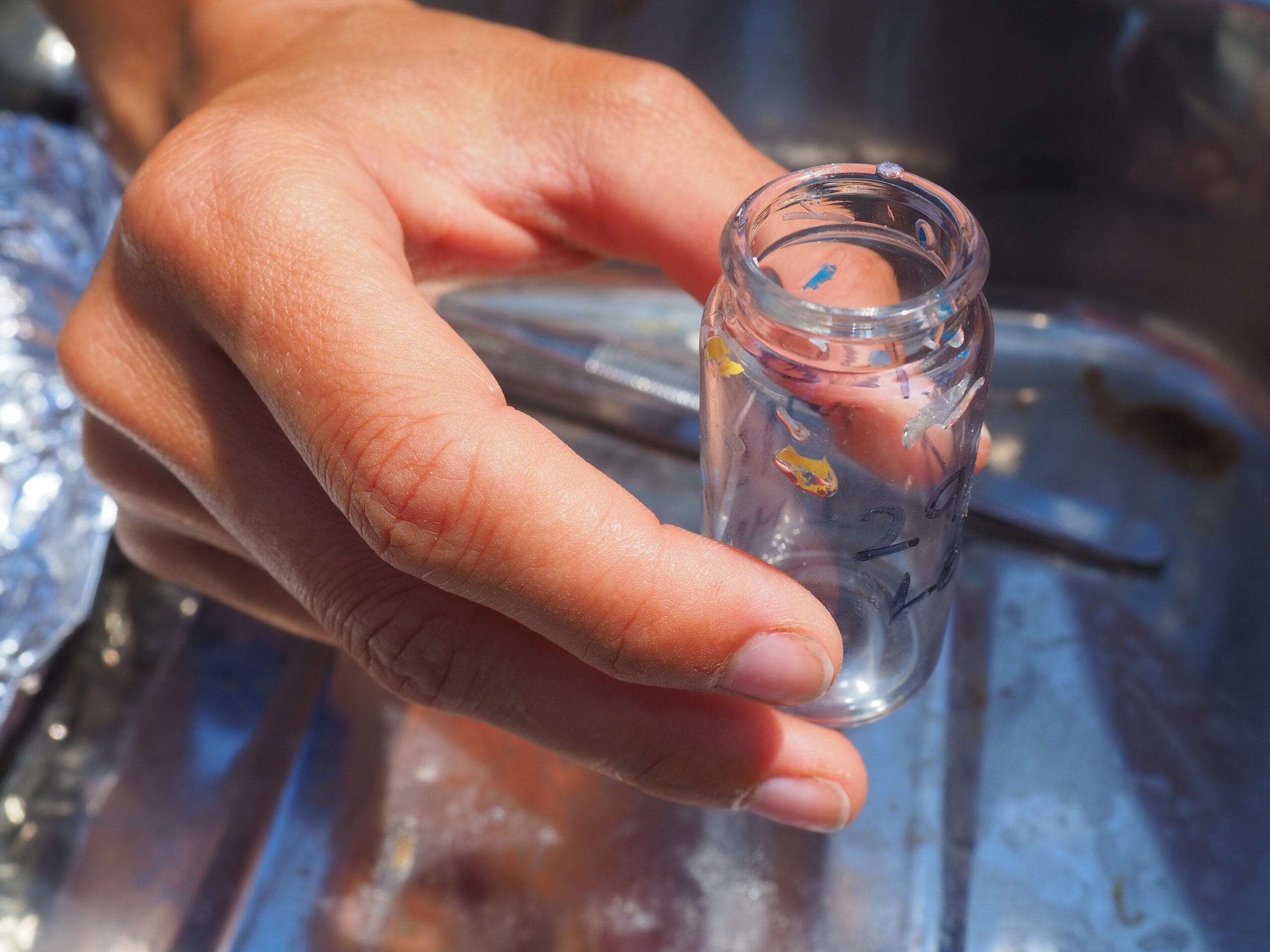
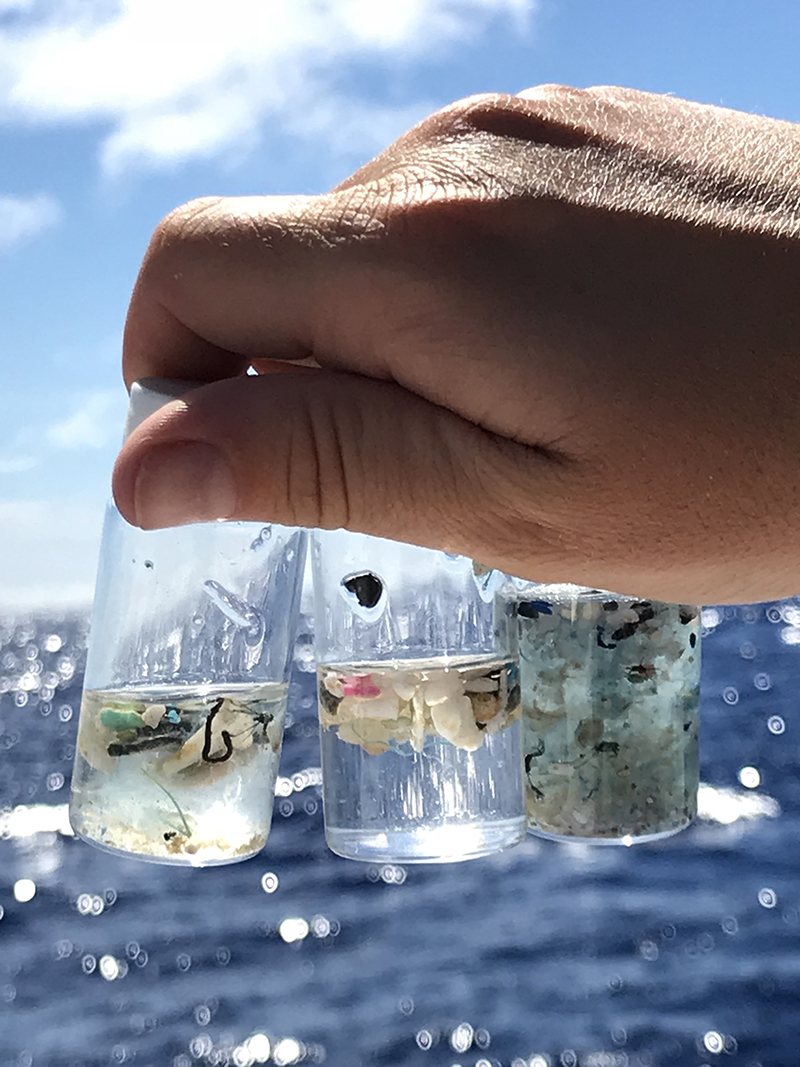
Ten days into our voyage. Every mile brings us nearer to the gyre and ever trawl brings up an increasing amount of plastic: translucent filaments which coil inside our sample bottles; flecks of blue, green, white, too small for the AFTR on board so these will need to be analysed back in the lab in Plymouth; a black mesh, still pending analysis.
Thirteen days into our voyage the sea gods smile on us and the sea is almost eerily calm as we enter the South Pacifiic Gyre. We have sailed over 1700 miles and are in one of the remotest areas of the Pacific Ocean, nearing the most remote inhabited island in the world. We spend the morning and afternoon dropping the manta trawl and Niskin and analysing the results. We are shocked at what we find: our trawls within the Gyre bring up five times more microplastic, microfibres, and film than the total of all the other trawls we have carried out outside the Gyre on this voyage.
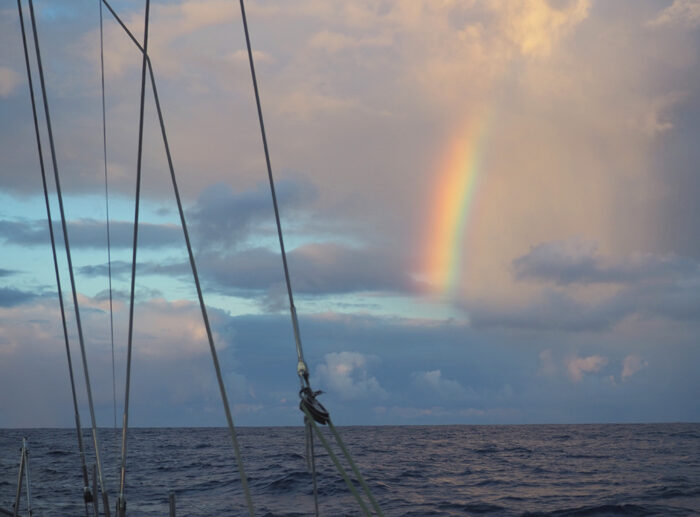
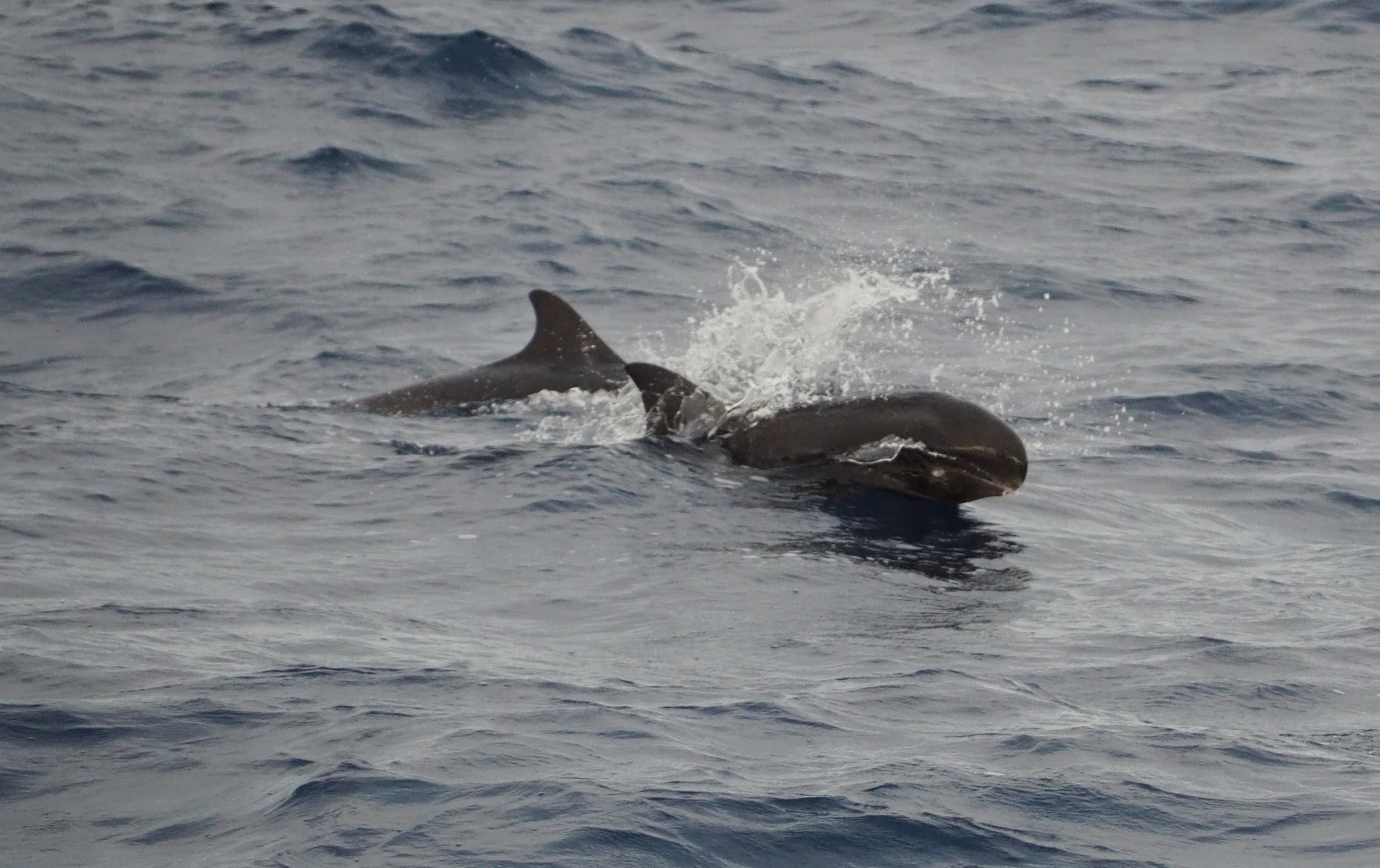
Almost every watch continues to bring its moments of awe at the sublime beauty surrounding us: the evening a school of pygmy killer whales played in our bow waves; the pinks, purples and oranges the sun paints the clouds as it sets a little later every evening on our journey south; and this morning when we saw a bright flash of rainbow suspended in a cloud at sunrise. The rainbow is a symbol of hope the world over which transcends the scientific explanation behind this regularly occurring phenomenon formed by the meeting of sunshine and water.
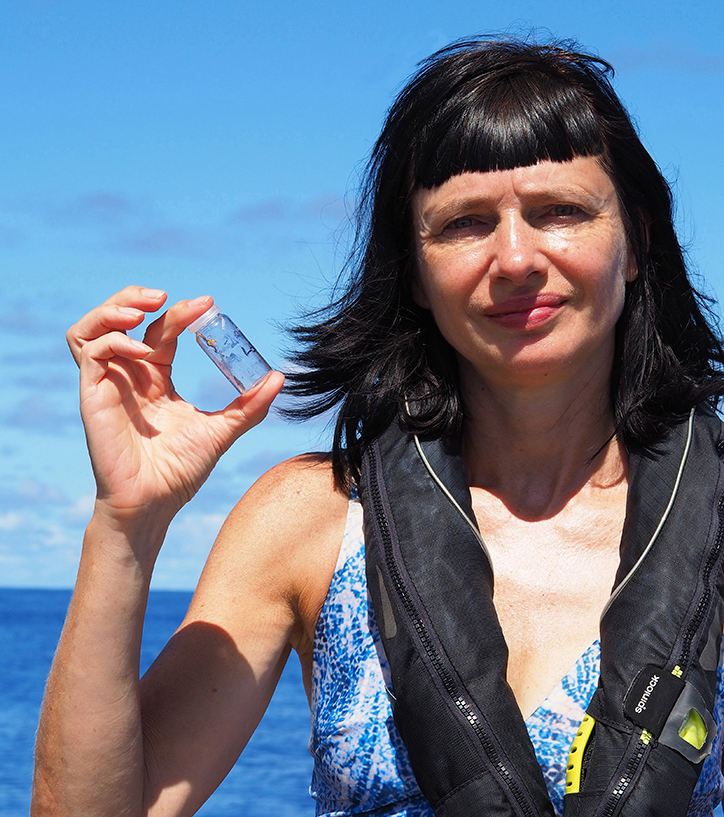
And herein, perhaps, lies the pathway towards finding an answer for our challenge. We need to engage people around the world in the fight to preserve the beauty and biodiversity of our oceans. We need to use the groundbreaking science we are collecting on board as a tool, but also engage people in an emotional response to the problems of plastic pollution.
A little over 200 years ago, the great explorer and scientist Alexander Von Humboldt travelled through Latin America. The Humboldt Current is named after him, an upwelling current bringing nutrients up from the deep but also bringing with it some of the tide of plastic which makes its way into the South Pacific Gyre. Humboldt’s scientific method encompassed art history, poetry and politics but in the intervening years scientists have pursued ever-narrowing areas of expertise.
The crew on board this eXXpedition voyage has been selected for our multidisciplinary set of skills and we need to work together to rediscover a multidisciplinary approach. In a world where we tend to draw a demarcation line between science and the arts, the subjective and objective, we need to reconnect science with our emotions, because we only protect what we love. I would like to think that this morning’s rainbow is nature’s way of telling us that there is hope for our oceans if we can find ways to make people around the world fall back in love with the science and poetry of this boundless deep blue sea.
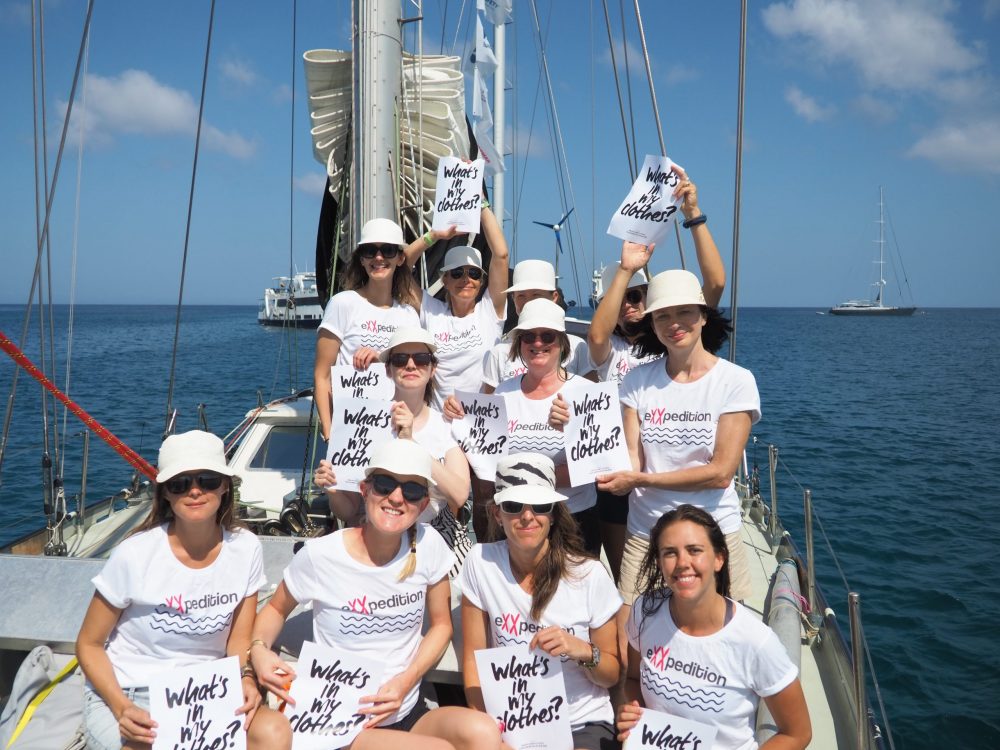
There are three things I have been passionate about over the course of my life: sailing and the sea, the indigenous cultures of South and Central America, and creating a more sustainable fashion industry.
Working with Pachacuti, the hat brand I founded over two decades ago, and at Fashion Revolution over the past six years, has brought together the latter two areas in many ways, but now I am incredibly excited to be able to draw all three of these strands together. In February and March 2020, I will be setting sail with eXXpedition to investigate plastic pollution and toxics in our oceans. Almost 10,000 women from around the world applied to take part in the two year voyage and I feel incredibly fortunate to have been selected to crew on the leg from the Galapagos to Easter Island.
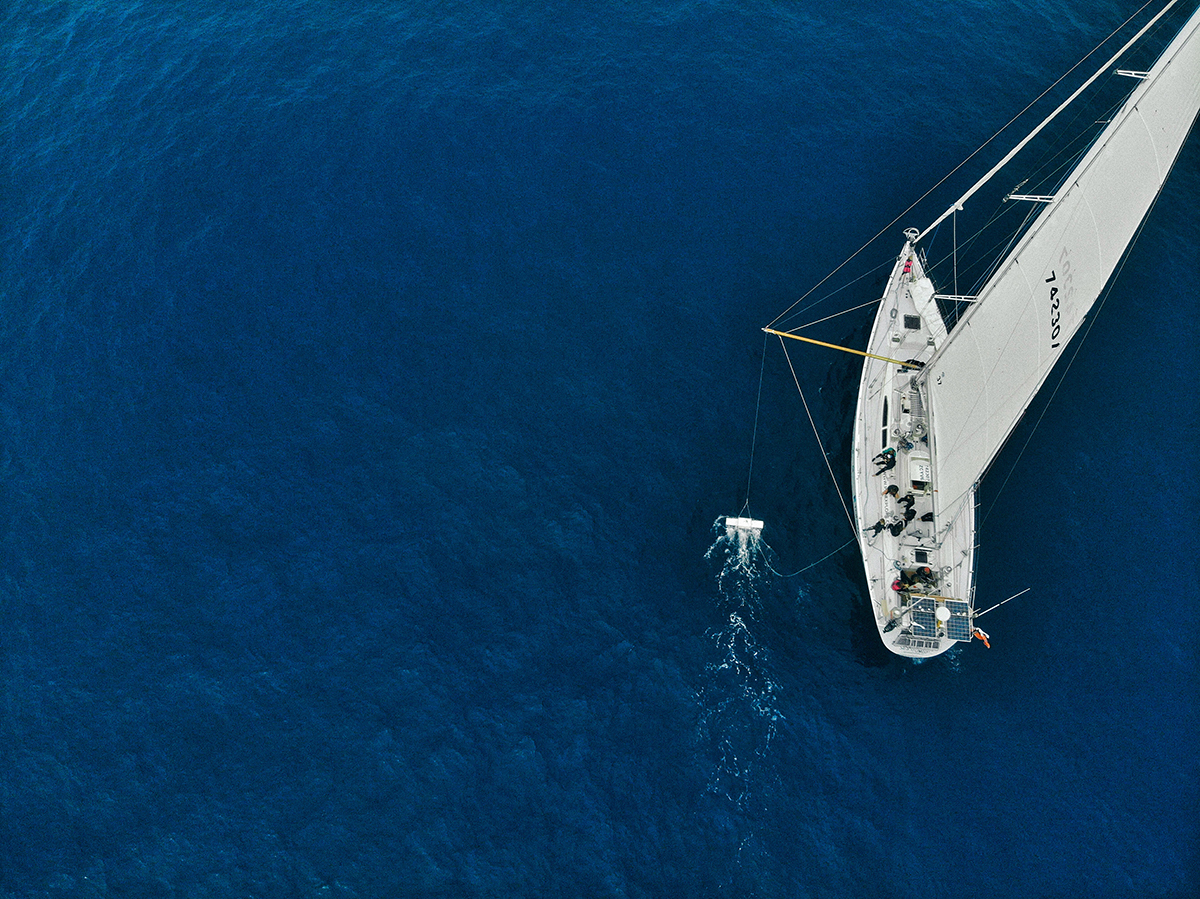
I learnt to sale on the magnificent J-Class yacht Velsheda in the late ’80s and spent a few summers as crew before jumping over to the square rigged brig TS Astrid on which I spent many happy months sailing the Channel and taking part in the Tall Ships Race. I then worked on various boats in the Caribbean for a year and sailed across the Atlantic on the tops’l schooner TS Unicorn. I remember night after night on the seemingly pristine sea watching the glowing, glittering phosphorescence resulting from the bioluminescence of organisms in the surface layers of the sea (we took two months crossing the Atlantic so there were plenty of sea sparkle nights to enjoy!) I never imagined that I would be sailing the oceans again three decades later to carry out research into the degradation of the marine environment.
My Masters in Native American Studies at the University of Essex was the culmination of an interest in the Andean region which stemmed from somewhere far back in my childhood – I remember asking for a picture book about the Incas as a Christmas present one year when I was still quite young. I immersed myself in learning about indigenous cultures past and present and would have continued with my PhD on the symbolism of colour and natural dyes in the Andes. However, having set up Pachacuti in the summer holidays and seen at first hand the real difference fair trade could make to textile-producing communities in Ecuador, I decided to turn my interest in the region to more practical use.
One of the key concepts of the Andean worldview is ayni, meaning reciprocity and balance. Balance does not mean just a static equibrium; the Inca strived for the creation of an animated cosmos through a system of continual exchange based on mutual respect, justice, and solidarity. They saw reciprocity as the foundation for peace, resilience and enduring relationships with our environment and our community both near and far. Ayni was a continuous accompaniment to life in the Andes and the foundation on which society was based. Indeed, life itself can be seen as ayni.
If the equilibrium between communities and the natural world was altered, it could result in floods, or lack of rains. Andean peoples understood that ayni has to be recreated every day in order for regeneration to take place and, as a result, knew that they needed to give things up, to make sacrifices to restore balance. Reciprocity moves people beyond self interest in order to do something for the common good.
Perhaps it is not surprising that in 2008, Ecuador became the first country to legally recognise the rights of nature and two years later Bolivia adopted the Law of the Rights of Mother Earth. This means in practice that people can now sue on behalf of the ecosystem. The Ecuadorian Constitution says this will help to “achieve the good way of living, the sumac kawsay.” Nature is part of the social fabric of life, not a resource to be exploited. The Andean concept of good living or living well doesn’t mean living better than others, nor does it imply the accumulation of material wealth. It means living well together, with nature, with mutual support, with ayni.
I was reminded of this whilst on holiday this summer, in a chalet by the sea on Branscombe beach in Devon. I was working there with my daughter, Sienna, and we were discussing stakeholders for Fashion Revolution’s policy dialogue toolkits. She told me that we must make sure we include stakeholders who don’t have a voice like the ocean and marine life. It seemed so obvious once she said it and I was astonished I had never previously thought of including them. This just emphasised to me how far we have become detached from seeing our world as a living being.
Reciprocity is inherent in the way the earth works, although there are limits that are difficult to reverse once they are crossed, as set out in the UN United in Science report issued on 22 September. Our activities, our pollution, our degradation of the marine environment are stressing the earth’s natural capacity for reciprocity. If we are to tackle toxics and plastic pollution in our oceans, as well as climate change, waste, and the myriad other environmental issues relating to the fashion industry, we know that every choice and every action matters. If we want to see regeneration of our waterways and oceans which are essential for living well on this planet together, we need to take co-operative responsibility. The resources of both land and sea are a gift, and this gift requires reciprocity in order to maintain healthy ecosystems.
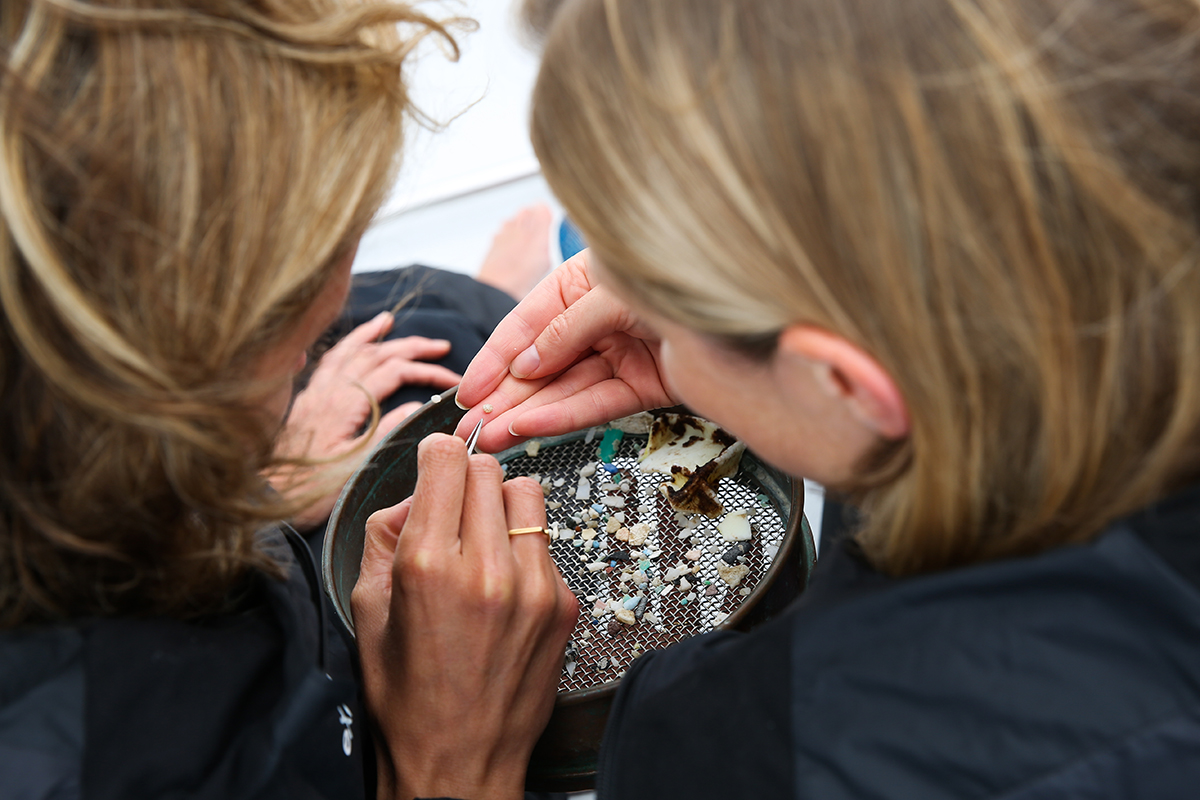
When I join eXXpedition and sail some 2000 miles through the Pacific Ocean, I will be taking part in groundbreaking scientific research on board this floating laboratory to help build a comprehensive picture of the state of our seas. I will also be helping to unravel how we got into this mess and how we can help shift our mindsets towards a more sustainable, a more balanced, future which encourages progress to a more regenerative system. The worldview of the peoples who inhabit the countries past which I will be sailing may well help us to find some of these solutions.
***
The eXXpedition Round the World voyage, which sets sail from Plymouth, UK on October 8th 2019, will sail through some of the most important and diverse marine environments on the planet. This includes crossing four of the five oceanic gyres, where ocean plastic is known to accumulate, and the Arctic on board 73ft sailing vessel S.V. TravelEdge. Under the directorship of award winning ocean advocate Emily Penn, 300 women will join the research vessel as crew over 30 voyage legs to journey more than 38,000 nautical miles. Follow news and updates via #eXXpedition @exxpedition on Twitter / @exxpedition_ on Instagram /eXXpedition on Facebook
I am looking for sponsorship and donations towards my participation in this groundbreaking voyage. Please see more information here – I am very grateful for any support.
Header photo: Soraya Abdel Hadi/eXXpedition

This website was created and maintained with the financial support of the European Union. Its contents are the sole responsibility of Fashion Revolution and do not necessarily reflect the views of the European Union.