Redefining collective action in Rajasthan and beyond
Words by Abby Brooks, Fashion Revolution New Zealand
Interview with Alexandra Simpson
Photographer credit: Mayuri Kataria
What are two things our fashion system needs more of?
- Empowerment of the (mostly female) talented garment workers across the world.
- Considered, artisanal, and slow production, that places deserved value on craft.
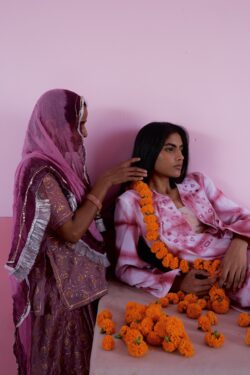 Saheli Women are doing just that, by working as a social enterprise which economically empowers women in Rajasthan through ethical fashion.
The main way they do this is by co-creating slow fashion garments with international fashion partners, utilising traditional craft practices and creating meaningful livelihood opportunities.
Their array of offerings spans across sample making, handloom, full production, quality and assurance, packaging and export, block printing, textile solutions and techniques, eco-printing, artisanal textiles, embroidery and natural dye.
Deserved fairness and respect
Saheli Women’s artisans receive a fair wage that is at least 50% higher than the national average income for similar work.
Their working days are also usually around 6 or 7 hours, whereas other garment workers in India and Bangladesh can often have a day exceeding 12 hours.
Empowerment beyond fair pay and shorter days
Additionally, they provide skills development training, transportation assistance, health insurance, on-site childcare support and flexible working options.
It’s paramount that they consciously create a safe and welcoming work environment free from gender, religious, and caste discrimination, all whilst committing to an extensive list of fair trade principles from the Ethical Fashion Initiative’s Code of Conduct, and adopting 9 of the sustainable development goals (SDGs).
 Centres designed to feel like home
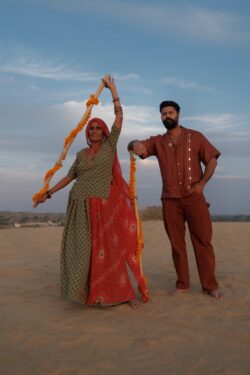
These are joyous spaces where women socialise, brew chai, cook, bring their children, and celebrate life and Indian festivals, regularly opening their doors to the wider community for cultural festivals and holidays. Strengthening this further, there are workshops on a broad range of topics such as human rights, feminism, menstrual hygiene, health, and financial literacy.
Volunteering at Saheli Women
We spoke to Alexandra Simpson (Ali) about her 3 months volunteering at Saheli Women. Studying fashion at Whitecliffe, Ali aims to be more environmentally conscious in her day-to-day life as well as her practise, especially after the 2013 Rana Plaza collapse and watching The True Cost (2015).
Now a sewing teacher, she shows people of all ages how to sew and create, whilst working for Aotearoa famous brand Ruby.
Ali had been following Saheli Women for years on social media, being drawn into their Mahi and what they stand for. Plus, India is arguably the best country in the world to learn more in depth about fashion and textiles.
“I wanted to be able to give my support, learn and get a hands-on experience of what it would be like alongside the women who make ethical and sustainably made garments from start to finish and how they are doing processes within fashion differently and changing the industry.”
A life-altering experience
“I learned a lot about sustainable fashion practices and it was a very expansive experience. I don’t think you can go to India and come back the same!”
Ali emphasises that the contrast between India’s bright, colourful, loud and sense-stimulating aura, and New Zealand’s small-town atmosphere, was a particularly powerful way to learn and grow as a person, with a highlight of being able to connect with all of the ladies from the centre with minimal English and Hindi.
“I will cherish the moments of just drinking chai outside with the natural dye ladies and yapping away about life.”
Redefining collective action
Following her volunteer experience, Ali now defines collective action as people coming together to support a vision, even if that vision is beyond your imagination. Despite language barriers creating an added challenging layer, they just make it work.
“At Saheli Women, we were working with international brands, which is pretty amazing to see how two cultures can come together and work together. Working with people not only close geographically, but all parts of the world, has allowed Saheli’s story to be shared worldwide.”
She felt the collective action instantly and consistently, throughout the whole process of production practices.
“Whether that’s the pattern master showing the ladies a certain sewing technique or someone is off sick or away, so they all have to chip in to get the garments done! They all function together, which is beautiful. Collective action is constant.”
An unforgettable sense of devotion
After a long day at the Bhikamkor Centre, the sun would set, a local village lady would play on a large drum, as Madhu and others would be doing puja at the temple and singing mother goddess songs. Everyone would be packing up whilst kids laughed and played.
“The first time I experienced this, it moved me, it was so powerful. It is one thing to create something that is empowering this community, but I find it so special to be interwoven with religion and spirituality. It’s such a sense of devotion.”
 Altering the perception of fashion and community
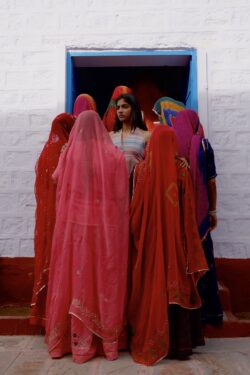
For Ali, experiencing ethical fashion from the ground up created a newfound level of respect and genuine understanding of the hard work that goes into manufacturing: something totally unfathomable to most of us.
It truly solidified her values on garment repair, eco-dying and the overall importance of sustainability and circularity.
“What you see on Instagram with any brand is the beautiful process and reaping of their hard work. I respect the hustle a lot. It’s nowhere near as easy as it seems to put the sustainable practices to work.”
Intangible learnings
Volunteering can teach you many values to be translated into your personal and professional life. For Ali, she’s now placing more emphasis in her work on community and empowerment. The strength, willingness to learn and perseverance during hardships she witnessed was particularly inspiring.
At Saheli Women, community really is everything, as well as the depth and vulnerability shared in this safe space. Across many societies, these values have been sadly lost.
“I find I’m already taking these in and applying them in my work and personal life. Yes, there can be differences within any culture, but this allows you to be more open, connect more deeply and appreciate what they have to offer.”
How to support and get involved with Saheli Women
Saheli have just released their first menswear collection called Jazam: an ode to the Jazam Mattress and coming together in community. It has elements of Pattu weave, natural dyeing and Shisha embroidery.
“It was really amazing to support this photoshoot and there is so much meaning behind it. It was shot at both centres and at the sand dunes near the village. Everyone was involved and it was a magical day.”
Their collection, photographed by Mayuri Kataria, is now live. Check it out on their website https://saheliwomenshop.com/ or Instagram https://www.instagram.com/saheliwomen/.
Can you support collective action, even in small ways?
Ali believes this can be achieved by starting where you are. Whether it’s at work or with peers, you can find out what it is that you’re truly passionate about to support the greater good, and take small actions towards that.
“Research that and look into it, you’ll always be surprised by what other people have done to support the cause.”
Starting at the workplace, you don’t need to be in a sustainability or green focused job title. We all play a part in bettering the future.
Whether it’s digitising marketing material and implementing digital business cards to avoid printing, suggesting carpooling or bike-to-work schemes, ensuring correct recycling procedures are followed, or even getting the team to take part in volunteering initiatives, these actions are all within reach.
When it comes to friends and family, reinventing the perception of “fun” and “cool” is a highly effective way to encourage collective change.
Suggest activities which are kinder to people and the planet, such as: volunteering, supporting local up-cycling and circular events, op-shopping instead of the mall, going to the indie cinema instead of a chain, swapping clothes before a night out instead of buying new, visiting the local produce market, and going to the independent veggie restaurant instead of a chain.
At home, you can curate your social media feed as a constant reminder of what’s important. Follow activists, circular accounts, sustainability news accounts, eco-conscious creatives and second hand fashion influencers.
It’s very eye-opening to read, watch and research more on the causes you’re passionate about. Listening to, and amplifying, BIPOC and indigenous voices is especially important for learning about systemic injustices and how to be truly respectful to people and the planet.
You don’t need to think big. You don’t need to be perfect. Change doesn’t come from just one person.
It comes from collectivity.